Streaming ASR Word-Level Confidence Scores for Downstream NLP Use
Confidence scores let downstream systems judge which ASR words to trust.

- Written by
- The Voice Layer Editors
- Published
- October 4, 2026
- Reading time
- 8 min read
- Sources cited
- 8 sources ↓
What this covers
By assigning a reliability value to each recognized word, downstream systems can decide what to trust instead of treating all ASR output as true. Since ASR engines produce hypotheses rather than certainties, many core NLP applications depend on distinguishing solid predictions from mere guesses. Google's research on estimating confidence across multiple tasks identifies the primary consumers of such scores, noting that semi-supervised alongside active learning, combining systems, conversational agents, and spotting keywords each rely on word-level certainty to avoid forcing humans to replay audio. At Interspeech 2025, the TruCLeS study pushed those applications toward far riskier domains, showing that when identifying Alzheimer's disease or depression, a flawed score threatens patient assessments rather than merely corrupting text. Since ASR outputs are inherently uncertain, the reliability metric must yield a dependable figure that genuinely captures such ambiguity.
Word-Level Confidence Scores from Subword Tokens
Words are not what end-to-end ASR systems output directly. Instead, they output subword tokens, with word-level confidence derived later by combining the constituent tokens' softmax scores for each word. Take a word with two legitimate tokenizations: one yields a pair of confident tokens that combine into a strong score, whereas the alternative segmentation of that same word yields a weaker combined score stemming from how it was divided rather than how well it was recognized<sup>2</sup><sup>1</sup>. Google's paper on word-level confidence points to this as the core difficulty in training confidence models at all: accurate ground truth labels for word-piece correctness depend on the tokenization being known, yet the hypothesis may follow a different valid segmentation from the reference, and this discrepancy by itself produces unreliable labels. Streaming setups compound the problem: confidence must be assigned before seeing the complete word or utterance, forcing aggregation over partial hypotheses, whereas offline calibration with full context faces no such constraint.
Why Raw Softmax Output Is Systematically Overconfident
Because their learning is driven by ordinary maximum likelihood, these networks become too sure of their predictions; later tuning is not the source. For TruCLeS, this condition defines the field’s starting point: DNNs are frequently overconfident, leaving ASR model calibration weak. Google's word-level CEM study locates one cause in how the model is trained: regularizing labels and feeding sampled prior outputs can soften softmax spikes, yet the smoothed scores still align poorly with whether words are actually correct. Noise instead interacts with the error and makes it worse. As audio quality drops, networks begin expressing strong certainty about wrong outputs, widening the divide between reported likelihood and actual accuracy precisely when later stages rely on it. Most teams train auxiliary confidence models using an approach that merely compounds the problem. Giving correct tokens a 1 and mistakes a 0 is still how auxiliary Confidence Estimation Modules are typically taught, yet TruCLeS reveals that such a setup fails to distinguish near-miss substitutions from entirely incorrect words. Since identical labels cover both cases, the network grasps only right-or-wrong rather than error magnitude, stripping away nuance before later stages can use it.
The main architectural approaches to calibrating word-level confidence beyond raw softmax
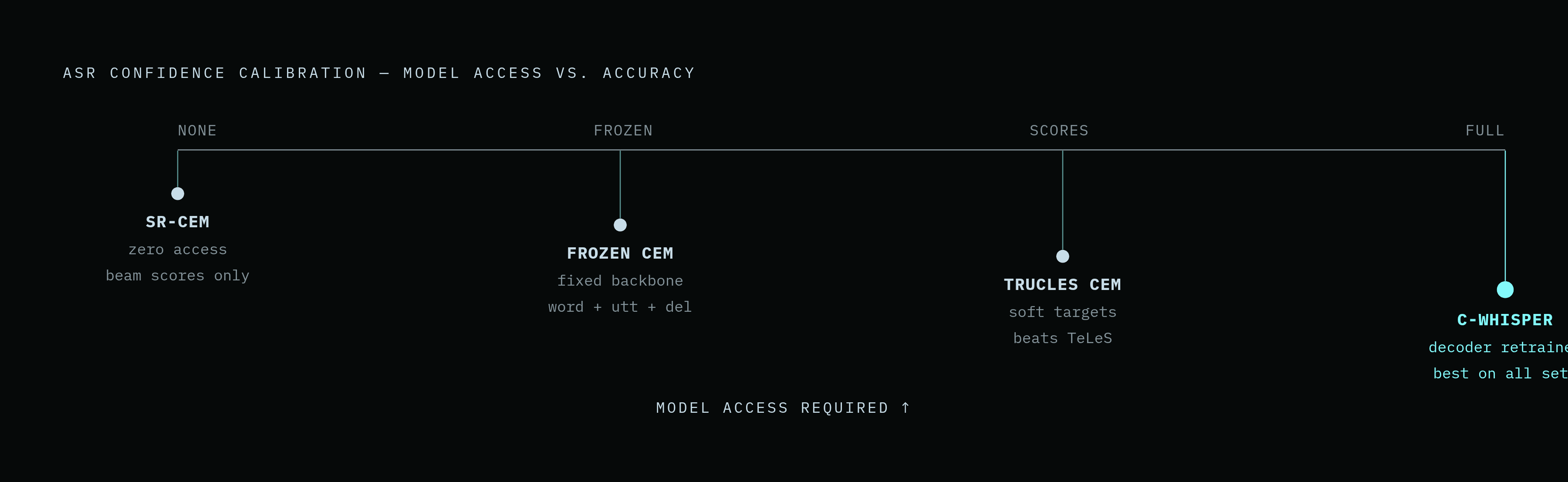
To address the shortcomings of unmodified softmax probabilities, three distinct architectural approaches have emerged, each targeting a specific limitation that deployment teams encounter. The earliest and most widely adopted solution keeps the ASR backbone frozen while attaching a lightweight auxiliary Confidence Estimation Module trained atop it. By jointly optimizing for word-level reliability, utterance-scoped certainty, and deletion forecasting, Google expanded this framework to boost NCE alongside AUC and RMSE while keeping the estimator's footprint unchanged<sup>1</sup><sup>2</sup>. That same multi-objective system leverages its utterance-scoped certainty scores to rerank candidates across proprietary voice search and maps corpora. These methods share a structural dependency: typical CEM designs require visibility into both encoding and decoding states, creating friction whenever the underlying ASR system operates as an opaque API instead of a locally inspectable model.
The second strategy holds on to the CEM design but replaces the binary target score with one that says more. TruCLeS comes from a team at CSIR-4PI and IIT Kanpur, and it trains its confidence estimation model on a score blending true class probability and lexical similarity of the prediction to the ground truth, letting the model learn how bad an error is, not just that one happened. Evaluated with RNN-Transducer and CTC systems alike, it beats TeLeS, a forerunner built on continuous targets that needed forced alignment over time and faltered when its timestamps were off.
A third strategy avoids changing the architecture entirely, because it relies solely on existing beam search outputs. Presented during ICASSP 2026, the SR-CEM (Score-Rank Confidence Estimation Module) builds features from each token's score, its rank, top-K values, and cumulative context totals within a hypothesis, data that any beam search naturally provides irrespective of the base architecture. Consequently, SR-CEM functions with attention-only, CTC-only, RNN-T, and combined CTC/Attention frameworks without requiring access to model-specific hidden representations. When organizations lack permission to alter their licensed or deployed ASR backbone, such flexibility becomes the deciding factor.
A fourth path, set somewhat apart from its three siblings, drops the auxiliary module entirely and instead trains the ASR model itself to emit confidence directly. C-Whisper from Sprinklr, which appeared in February 2025, retrains only the decoder inside a copy of Whisper, leaving the encoder untouched, making the model emit a single scalar score per word, computed from the audio and the candidate transcript, with a word's confidence read from its final token's value. The retrained Whisper-tiny matches a solid CEM baseline within its own domain and surpasses it beyond that domain, while the retrained Whisper-large wins by a wide margin on every dataset tested. Which of the four routes a team should take hinges on what it truly controls: if the ASR backbone is open to modification, if portability of the architecture outweighs sheer accuracy, and if the latency budget for streaming can spare a second forward run of a confidence module.
Calibration in a Streaming Context
For streaming use, calibration is a more limited target and tougher to get right than offline. Offline, a CEM can wait until it has the entire encoder output plus all beam-search candidates, then assign a word its confidence score. A streaming system lacks that option: it has to output an early word’s confidence while the future evidence needed to clarify it is still unavailable. Whisper makes the practical burden clear: because it was designed for non-streaming use, it does not output native word-level confidence, only per-token log-probability scores that must be turned into word confidence afterward. In practice, teams putting Whisper into streaming workflows must either add a CEM layer or train it along the lines of C-Whisper; when they choose the add-on route, it generally runs after the transcript is finished, introducing delay that real-time streaming needs further engineering to handle.
Noise makes this degradation worse rather than merely increasing it. A Dutch child speech study illustrates the effects of letting confidence scores govern which utterances survive filtering amid heavy noise: despite careful selection design, few utterances in the most degraded dataset meet the stringent confidence requirement. This forces a fundamental tension between recall and reliability onto confidence-gated systems regardless of whether they stream. Because SR-CEM draws exclusively on beam-search outputs, it holds an advantage here: it skips the extra traversal of encoder states required by cross-attention CEMs, and omitting that step means less additional delay.
How Downstream NLP Tasks Consume Confidence Scores
When a later component relies on word-level confidence, miscalibration breaks it in its own way instead of simply making recognition errors climb. For semi-supervised and active-learning setups, overconfident scores let bad transcripts be added to self-training data as if already checked, so the mistake grows with every training pass instead of being caught. In Google's CEM study, this dynamic is put to better use: confidence-guided model selection sends low-scoring audio off the device, where a hybrid recognizer with help from broader language-model context handles it, yielding a 9.6% error rate for words on the rare-word benchmark, better than either model alone.
Voice agents and spoken dialog systems depend on confidence to choose whether to proceed with a potentially flawed result or ask you for correction. Such a decision requires the metric to reliably distinguish mistakes from accurate transcriptions. An overconfident metric causes the system to quietly accept mistakes rather than asking you to verify or say it again.
These search tasks still hinge on the same per-word confidence cutoff: scores above it register as hits, scores below it do not. When confidence is set too high, extra false alarms creep in with the threshold itself left alone, quietly eating away at precision until someone checks the output. In CEM work from Google that trains several tasks jointly, keyword spotting draws on that score directly, and the paper ties better calibration of utterance-level scores to lower word error rate after rescoring, so the benefit of fixing calibration extends past the hit/no-hit decision and lifts transcription quality as well.
In Speech translation, word-level confidence guides whether each transcript segment can already go to the translation model or must be re-processed, while streaming systems must make that call piece by piece rather than waiting for the utterance to finish. That need is why TruCLeS identifies speech translation as a direct driver for confidence-estimation research.
Clinical use is where the stakes are highest, and TruCLeS uses screening for Alzheimer's disease and for depression to show how misplaced certainty can cause serious consequences. Here, a model that is wrong yet too sure of itself is not merely a release-cycle bug, but something that can put clinical decisions and treatment at risk.
Aggregation strategies that turn token-level scores into reliable word-level signals
After token confidences have been computed, reducing them to one score for a word is a substantive design choice: it determines which errors the signal will catch best. Taking the floor across the pieces that compose a word is the most cautious option, since any low-scoring piece lowers the score for the entire word. For keyword spotting, this cautious bias is useful: false alarms are costly, while failing to fire is the less risky error. In speech translation, however, that minimum rule may over-prune, depriving the translation model of useful input despite largely correct subword evidence. Choose the word-level combiner according to the task’s failure mode: substitutions call for different treatment than deletions, so the scoring rule, whether floor, average, or trained fusion, should reflect that tradeoff rather than a default.
Methodology & sources
- ASR Confidence Estimation using True Class Lexical Similarity Score
Provided the TruCLeS framework details, including its application to clinical domains like Alzheimer's and depression screening, its critique of binary confidence labels, and the overconfidence problem in DNNs.
- Adopting Whisper for Confidence Estimation
Provided details on C-Whisper from Sprinklr, including its decoder retraining approach and cross-domain performance results.
- Learning Word-Level Confidence For Subword End-to-End ASR
Provided the discussion of subword tokenization ambiguity and the 9.6% error rate result for rare-word benchmarks using confidence-guided model selection.
- Multi-Task Learning for End-to-End ASR Word and Utterance Confidence with Deletion Prediction
Provided the multi-task Google CEM framework details, including joint optimization for word-level reliability, utterance-scoped certainty, and deletion prediction, plus keyword spotting and rescoring applications.
- Leveraging Beam Search Information for Confidence Estimation in E2E ASR
Provided the SR-CEM approach that builds confidence features exclusively from beam search outputs, enabling architecture-agnostic confidence estimation.
- TeLeS: Temporal Lexeme Similarity Score to Estimate Confidence in End-to-End ASR
Provided background on TeLeS, the temporal lexeme similarity forerunner to TruCLeS that required forced alignment and faltered with timestamp errors.
- An evaluation of word-level confidence estimation for end-to-end automatic speech recognition
Provided the evaluation framework for word-level confidence in end-to-end ASR, informing the article's discussion of aggregation strategies and downstream task consumption.
- Transcribing Children's Speech: ASR Performance and Obtaining Reliable Orthographic Transcriptions
Provided the Dutch child speech study illustrating how confidence-based filtering under heavy noise leaves few utterances meeting stringent confidence thresholds.