Automatic Speech Recognition Accuracy by Accent and Dialect
- Written by
- The Voice Layer Editors
- Published
- September 30, 2026
- Reading time
- 10 min read
- Sources cited
- 7 sources ↓
What this covers
Speech recognition makes written words out of audio through machine learning and signal processing, and its output underlies assistants for voice, captions on YouTube, Zoom, and Microsoft Teams, transcription work, plus a swath of accessibility apps disabled people count on every day. To gauge how reliably any of that performs, the field leans on a single metric: Word Error Rate, or WER, the share of words a system botches. Smaller scores win. It's blunt in a way that lets anyone follow along, no linguistics training required.
Careful transcribers reach roughly 4% WER. That 4% is the informal ceiling everyone in the field works from. ASR systems routinely exceed 4% WER on varied speech inputs, while the performance gap is uneven: for some speakers it widens and for some it narrows. That gap doesn't hit all speakers the same way. For some speakers, it widens; for different people, it narrows based on identity and speech.
That unevenness is what this piece is all about. WER is a good starting point because it is observable and measurable: a vague complaint, like "my app doesn't understand me," becomes a percentage across vendors, dialects, and over time. But one overall WER score conceals what matters most. A system can perform well overall yet keep getting one demographic group wrong, and that problem stays hidden unless the results are split out by speaker. That breakdown is what comes next.
The disparity WER reveals: African American English and the Koenecke et al. findings
Researchers examined 5 ASR systems (Amazon, Apple, Microsoft, IBM, and Google) using structured interviews of 42 white speakers alongside 73 Black speakers across US locations, matching audio by gender and years lived. It's a solid sample across major vendors, not some single-app anecdote.
Black speakers saw a WER of 35%, while white speakers hit 19%, across all the systems checked. About one in three came back bad for Black speakers, against roughly one in 5 on that same task for white speakers. Since every single vendor matched that pattern, the gap belongs to the whole industry, not just one company's blind area.
A follow-up in 2022 dug into the cause, and its finding explains the headline gap: speech sounds are phonetic. Put simply, African American English shares its vocabulary and grammar with varieties spoken elsewhere. The acoustic component that links audio to phonemes mishears the speech. That difference puts the responsibility squarely on how the systems learn from audio, not on any flaw in the dialect. Koenecke drew on a single corpus, from one point in time. Until recently, nobody knew if that pattern would survive a new dataset, other vendors, and more time for model development.
The 2025 Pacific Northwest English study
The pattern holds, and it extends past racial identity. Across every system, the figures line up.
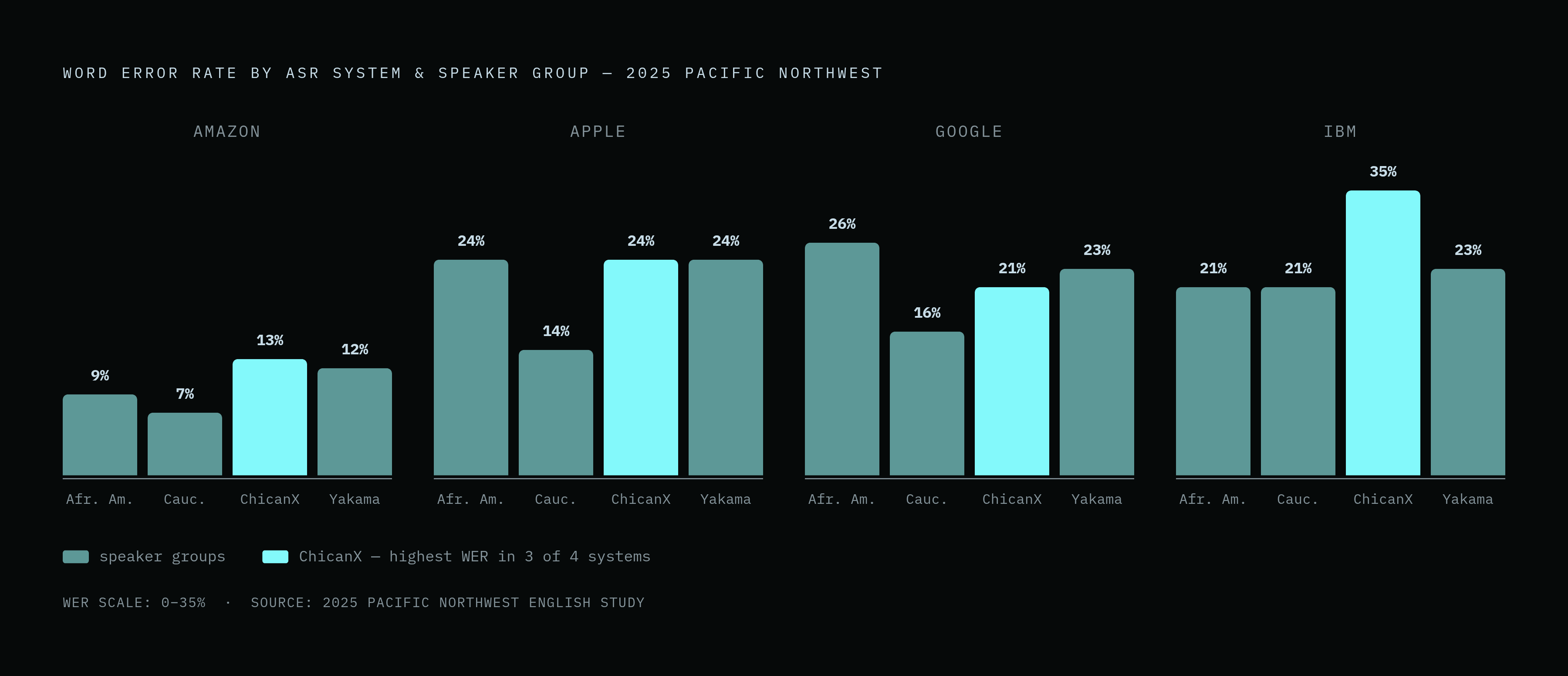
For African American speakers, Amazon's error rate was 9%; for Caucasian American speakers, 7%; for ChicanX speakers, 13%; and for Yakama speakers, 12%. Google came at 26% with African American speakers, 16% with Caucasian American, 21% with ChicanX, and 23% with Yakama. IBM's numbers were 21% for African American speakers, 21% for Caucasian American, 35% for ChicanX, plus 23% for Yakama.
Across systems, African American speakers had a mean WER of 20%, versus Caucasian American speakers at 15%, a 33% relative gap marked as strong (p < 0.001) by mixed-effects models using speaker as random. The difference held up. Researchers examined 11 sociophonetic things and learned vowel quality variation, specifically refusal of the low-back merger or pre-nasal merger patterns, tracked error rates, with African American speakers faring worst across every tested system. The low-back merger blends vowels from items like "cot" plus "caught" into a single one across many American dialects; speakers who keep those vowels apart produce patterns that acoustic models, trained mainly on merged speech, fail to recognize and misread. That pattern fits the 2022 conclusion: the gap originates in acoustic modeling rather than word choice or grammar.
One point stands out. Amazon posted the smallest WERs across groups yet kept that pattern of disparity intact, proving better overall accuracy won't automatically erasethe gap. Improving overall doesn't automatically yield a fairer system. Those are two separate engineering problems, and solving one does not solve the other. The Pacific Northwest English (PNWE) corpus evaluated Apple, Amazon, Google, and IBM across several ethnic groups in a 2025 sociophonetic study. In that study, Apple had word error rates of 24% among African American, 14% among Caucasian American, 24% among ChicanX, and 24% among Yakama speakers.
Regional dialect bias in the UK and rural US: Newcastle English and Appalachian English
The pattern extends well beyond race and ethnicity. It shows up when a speaker's variety sits well outside the norm in the training data, and geography matters just as sharply as ethnicity. In the UK, Southern British English speakers post the lowest error rates, while those in Northern England and Northern Ireland deal with much steeper ones, a gap traced back to how underrepresented those dialects are within training data.
A 2025 study at Interspeech focused specifically on Newcastle English, using a two-stage approach: checking a subsample by hand to catalog phonological mistakes alongside lexical and grammatical errors, then examining the regional pronouns "yous" plus "wor". Those two small words turned out to be a clean diagnostic. The regional dialect is what ASR errors tracked, and it caused most mismatches rather than speaker demographics. When a single unfamiliar pronoun repeats across a transcript, it can disrupt much beyond one word if the system tries to compensate for it.
Appalachian English shows the same pattern on another continent. An American Speech 2025 study set speakers from Southern Appalachia in Eastern Tennessee beside a reference group from Central Pennsylvania, with read-aloud text from “Goldilocks” and the “Three Bears” plus the Rainbow Passage, processed by the Dartmouth Linguistic Automation system. The phoneme error rate for Southern Appalachian speech exceeded that of the non-Southern reference group. Together, they reveal a compounding disadvantage for regional varieties that are stigmatized or underrepresented across rural US and the UK: training data underrepresents them, and existing acoustic models miss their phonological patterns.
Non-native speakers and the L1/L2 divide in ASR performance
Non-native English adds a whole extra layer, and the patterns fall out in ways most folks wouldn't predict. (2022), plus open-source models like Whisper, as Graham and Roll showed. In a JASA Express Letters 2024 study, Graham and Roll said Whisper was strongest on American English; British and Australian English did worse, while Canadian English was about level with American.
But the more striking finding goes against the expected ranking. A few groups of non-native speakers, Swedish and German speakers specifically, outperformed British English speakers. The researchers explained it more by consistency: British English includes many internally different accents, while speakers with one L1 background usually have similar pronunciation patterns a system can learn. Being native isn't what drives accuracy. Consistency with its training data predicts accuracy.
Graham and Roll linked errors to three factors: a speaker's prosody from their first language, the vowel set they use, and if the speech was spoken aloud or spontaneously. Whisper had more trouble with unscripted talk than read-aloud speech, no matter the accent. And the disparities go beyond phonology. A large-scale audit showed that ASR performance correlated, even after controls for several linguistic variables, with how aligned a speaker's home nation is politically to the United States, which pushes the explanation beyond linguistics toward structural inequity. One 2025 study examined an ASR system for clinical use, run only in German, and logged worse error rates for speakers not born in Germany, although every participant shared the same language. The gap remains even when the language is held constant.
How models compare across the performance landscape
Picking an ASR system to handle accented or dialectal speech means dealing with wildly uneven results, and no single vendor has bridged that gap. In research evaluating accessibility across accents, Whisper large-v3 achieved mean WER of 9.3%; Vosk en-0.22 reached 32.9%, over a threefold accuracy spread across models.
Even the best system there didn't hold up uniformly. In Whisper large-v3 itself, Haitian Creole and underrepresented languages like Sylheti showed substantially worse error rates, including character and keyword error rates, compared with French and well-resourced languages like English. In a 2025 benchmark built specifically for non-native accented speech, Google Gemini came out on top across formatting setups, while Whisper, AssemblyAI, and AWS did well without matching it. ZIPA and IPA/phoneme-based systems WhisperIPA, evaluated in 2026 by Patwari, Bao, Saha of the University of Utah, still show persistent disparities across language, gender, accent, ethnicity, and older versus younger speakers, showing phoneme-level bias can propagate downstream. Even in those tests, persistent disparities showed up across language, gender, accent, ethnicity, and speaker age, proving bias starts at the phoneme level and moves downstream.
Systems for general-purpose use, made around non-regional English, often underperform on regional speech or accented speech, and OpenAI's Whisper, AssemblyAI, and Deepgram show meaningfully stronger scores there than systems like Mozilla DeepSpeech. Gladia, which produced this report, builds ASR tools for that same challenge and competes with the vendors mentioned here. No system has fully closed the accent gap, and the data doesn't justify calling any one system definitively fairest. The data points to a narrower idea: equitable accuracy and overall accuracy are separate targets, so fixing one doesn't mean the other gets better.
The gaps: training data, acoustic modeling, and architectural choices
This structural gap starts with the simplest and clearest point: research on African American English specifically points first to a data shortage in training audio from Black American speakers. Models pick up on patterns after repeated exposure. When a dialect is underrepresented in training, the system has not heard it often enough to form a reliable representation.
That shortage compounds with another challenge: architecture. In most ASR systems, embeddings tuned and feature-extraction pipelines for generalized speech patterns can flatten subtler distinctions between accents, even when training data includes some accent diversity. Prasad and Jyothi's 2020 research traced accent signals to the earliest layers of these models, concentrated there before the system even begins modeling language, locking the bias in early. As soon as a transcript reaches a reader, the error is already baked in further upstream.
A useful predictive pattern appears here: phonological gap, measured against the training distribution, predicts error rate. Since Language embeddings cluster around geographic and lexical closeness, a model performs worse the more distant from its trained data a speaker's variety sits. Geographic and lexical proximity shape how Language embeddings cluster, and as a speaker's variety moves away from the training distribution, its error rate rises, making regional pronouns in Newcastle English and vowel quality variation from the PNWE study dependable error triggers. A 2026 study examining phoneme-level representations saw this pattern deeper in the system: disparities starting at the phoneme level propagate into all downstream layers, and though more phonetically robust representations might help with narrowing that gap, today's IPA-based systems leave disparities across eleven languages plus multiple demographic groups. Throwing more compute at this won't fix it. The Newcastle English study proves sociolinguistic error review already identifies the linguistic traits behind failures, handing developers a clear target instead of a vague mandate to do "better with accents".
What errors cost users in healthcare, education, and employment
ASR turns practical the moment its transcripts carry real-world consequences. A biased transcription can misrepresent a patient's words, obscuring their chronic symptom while risking an incorrect diagnosis or care path; research published in Frontiers of Artificial Intelligence shows accent bias persists even in hospitals where the stakes should force improvement.
In schools, the damage affects both kids and the systems meant to support them. ASR errors reinforce stigma around African American Language, change how a student's skills get perceived by teachers, and drive underachievement plus disproportionate placement in special classes, per research the ACM published; automated tools running on biased ASR inherit that bias and amplify it down the line.
Jobs carry their own kind of risk, though the findings here are more suggestive than airtight. HireVue and others already use ASR to analyze data like quality and word choice when ranking people applying for work, and the Journal of Applied Psychology published a 2024 study where Hickman examined bias specifically in interviews rated automatically. The clearest proven harm here is in captioning. Kadoma, Naaman, and Shrivastava's preregistered 2026 experiment at Cornell and CMU, involving 207 US-based crowdworkers, showed error-prone subtitles lowered ratings for the speaker and the material alike, plain and simple. When subtitle quality was held constant, accent groups showed no measurable disparity, which is exactly the point: speakers whose accents trigger more ASR errors get the worst subtitles, and those poorer subtitles are how they get judged more harshly by an audience that does not hear them.
The human cost beyond metrics: what affected users experience
No percentage point of WER can capture what it's like when a voice assistant ignores you repeatedly but understands someone across the house instantly. It doesn't capture when a transcription tool mishears a regional pronunciation and a chart ends up logging a symptom wrong. It doesn't capture a learner whose speech patterns an automated app flagged as an error needing to be corrected, not a dialect to understand.
The metrics here, 35% versus 19%, 20% versus 15%, and the threefold gap across commercial models, serve as proxies. They cover what can't be reduced to a percent: the steady, repeated work of being misread by a system others pass through without trouble. WER let this article make that burden visible and comparable across years, vendors, corpora. But the figure itself was not the point. It matters who must go on repeating themselves, and the industry making these systems has long had the data to see it.
Methodology & sources
- Lost in Transcription: Subtitle Errors in Automatic Speech Recognition Reduce Speaker and Content Evaluations
Provided the Cornell/CMU preregistered experiment showing that subtitle errors from ASR lowered speaker and content evaluations among crowdworkers.
- Evaluating Bias in Phoneme-Based Automatic Speech Recognition Systems: An Analysis of IPA Transcription Models
Provided evidence that phoneme-level IPA-based ASR systems still show persistent disparities across languages, gender, accent, ethnicity, and speaker age.
- Automatic Speech Recognition Biases in Newcastle English: an Error Analysis
Provided the two-stage Newcastle English error analysis identifying regional pronouns 'yous' and 'wor' as diagnostic markers of dialect-driven ASR errors.
- Evaluating the Accessibility of Automatic Speech Recognition Technology Across Accents - NHSJS
Provided the cross-model WER comparison showing Whisper large-v3 at 9.3% versus Vosk en-0.22 at 32.9% across accented speech.
- Dialect Bias in Automatic Speech Recognition: Analysis of Appalachian English | American Speech | Duke University Press
Provided the Appalachian English study comparing Southern Appalachian and Central Pennsylvania speakers using read-aloud passages and the Dartmouth Linguistic Automation system.
- A Sociophonetic Analysis of Racial Bias in Commercial ASR Systems Using the Pacific Northwest English Corpus
Provided the 2025 Pacific Northwest English corpus WER figures across Amazon, Apple, Google, and IBM for African American, Caucasian American, ChicanX, and Yakama speakers.
- Racial disparities in automated speech recognition | PNAS
Provided the foundational Koenecke et al. findings on racial disparities in ASR, including the 35% WER for Black speakers versus 19% for white speakers across five major commercial systems.