Noise Robustness Testing Methods for Production ASR Deployments
Production ASR systems fail in ways that standard benchmarks never measure.
- Written by
- The Voice Layer Editors
- Published
- October 8, 2026
- Reading time
- 10 min read
- Sources cited
- 1 sources ↓
What this covers
- How noise actually degrades ASR signals in production, and why isolated test conditions miss it
- Why WER alone cannot surface the failure modes that matter in production
- Constructing a Test Set That Reflects Your Actual Deployment Conditions
- Running the noise robustness evaluation: SNR sweeps, compositional conditions, and hallucination probes
Practitioners are misled by standard ASR benchmarks, since the audio they use bears no resemblance to real-world deployment conditions. Topping a clean-read leaderboard simply means optimization for a limited speech variety, worlds apart from noisy call centers or poor cellular links in the field. FLEURS sources its prompts from an open web encyclopedia, relying on domestic recordings that lack studio-grade acoustics or any standardized noise-floor specification. Its own publication acknowledges how far those collection conditions diverge from the noisier signals encountered in production. Such data trains systems to process scripted, polished delivery instead of the stammering, interruptions, and overlapping voices typical of actual support conversations.
That gap is built into the whole benchmarking approach. Top English ASR APIs now make so few transcription errors on pristine recordings that tests built from polished audio are too blunt to separate one system from another. The differences show up only when recordings involve background noise, accents, overlapping speakers, or specialized domains, precisely the cases clean benchmarks are designed to omit. Another issue deepens this one: the same public datasets can feed provider training and later reappear inside the benchmarks. Such favorable published WER figures may simply reflect training data leakage instead of genuine robustness against novel audio environments. Real-world recordings almost never hold every factor constant like a controlled test. For instance, a support line interaction might layer codec artifacts with background sounds from each participant plus simultaneous talkers, creating conditions that standard metrics never anticipated.
A benchmark ranking only identifies which model performs best under research conditions. It cannot predict what will hold up in deployment, so conflating the two contexts leads groups to adopt models that seem cutting-edge theoretically yet break down when facing real-world audio interference. Top placements on such lists frequently offer the least reliable guidance for this choice, because the testing environments never match what happens in production. Choosing a provider based on rankings is essentially wagering that live operations will mirror scripted audio datasets, which they never do.
How noise actually degrades ASR signals in production, and why isolated test conditions miss it
ASR errors do not all arise from noise in the same way. Instead, noise weakens the speech cues ASR follows, from vowel resonances and intonation patterns to rhythm and brief pauses that mark word and phrase boundaries. What gets hit depends on the noise type. A fan or HVAC system creates a steady hum that covers the low-frequency parts of the signal. Brief, changing sounds, such as a slammed door or scraped chair, can obscure consonants, the cues that often make one word recognizable against another. Overlapping talk poses the greatest challenge, since it breaks up the spectral patterns ASR needs to pick out the intended speaker amid other simultaneous sound.
Robustness studies typically isolate a single variable or two while keeping the rest fixed, an approach that real-world sound simply defies. In practice, acoustic distortions layer on top of one another. During actual use, echoes, reverberation, and dropped frequencies stack up simultaneously, yet datasets large enough to reflect such overlaps remain rare. Models tested solely on isolated interference lack experience with the overlapping degradations encountered during real conversations.
The kind of noise present matters separately from how loud it is. A model trained on one noise profile may excel under those conditions yet falter dramatically when facing another noise type at the same signal strength. Because benchmark scores average across conditions rather than separating them, this swing remains invisible. Phone calls make this worse. Standard 8 kHz telephone channels strip high frequencies and add codec compression artifacts even before any surrounding sound from the caller's location enters the mix. This layered combination of channel loss, codec compression, and environmental sound exceeds what single-variable tests were designed to measure.
Lab testing often overlooks a breakdown within the intake chain. In production, a pipeline may run its own suppressor on speech that the caller’s device has already cleaned up through OS-level or Bluetooth denoising. With every filtering pass, phonemic cues get thinner, and paired stages may discard more than either one was designed to lose alone. In a lab run, pristine lossless input goes straight to the model, bypassing this sequence and hiding the effect of a signal being filtered once before production filters it again.
When composition is badly distorted, ASR breaks in a qualitatively different way, not merely more often. Instead of piling up substitutions one word at a time, the model can omit entire utterances or output polished, assured text unrelated to the speech. About 1% of the transcripts produced by Whisper include unsupported hallucinations, but standard WER cannot score that failure because the invented material does not correspond to an error against a reference transcript. A credible test design therefore has to center on the recording chain as well as compositional noise.
Why WER alone cannot surface the failure modes that matter in production
Because it remains reliable, uniform, and easy to compare across systems, no rigorous assessment ought to drop WER. The metric was designed to tally replacements, omissions, and additions relative to a ground-truth text, performing admirably within its intended scope. Yet critical real-world breakdowns escape its scope entirely, so relying on WER alone to judge noise resilience causes most assessments to fail.
WER has no defined value on audio spans with no spoken content. On nonspeech audio such as sudden noise or silence, when the reference transcript is blank, model-generated words amount to hallucination rather than the substitutions WER is meant to measure. Above roughly 30% WER, the errors also take on a different character. Simple substitutions are replaced by badly distorted meaning and whole runs of missing sentences, while the combined WER score treats that qualitative change just as it treats a few scattered word errors.
Confidence scoring introduces another layer of risk that WER can't measure. Studies of ASR-TRA and similar dynamic adjustment techniques reveal that relying on certainty estimates often backfires amid acoustic interference, since networks frequently rate erroneous transcripts as highly reliable. When acoustic interference leads a network to assert wrong answers with conviction, the resulting downstream damage exceeds that of a system admitting doubt, though WER scores them equally.
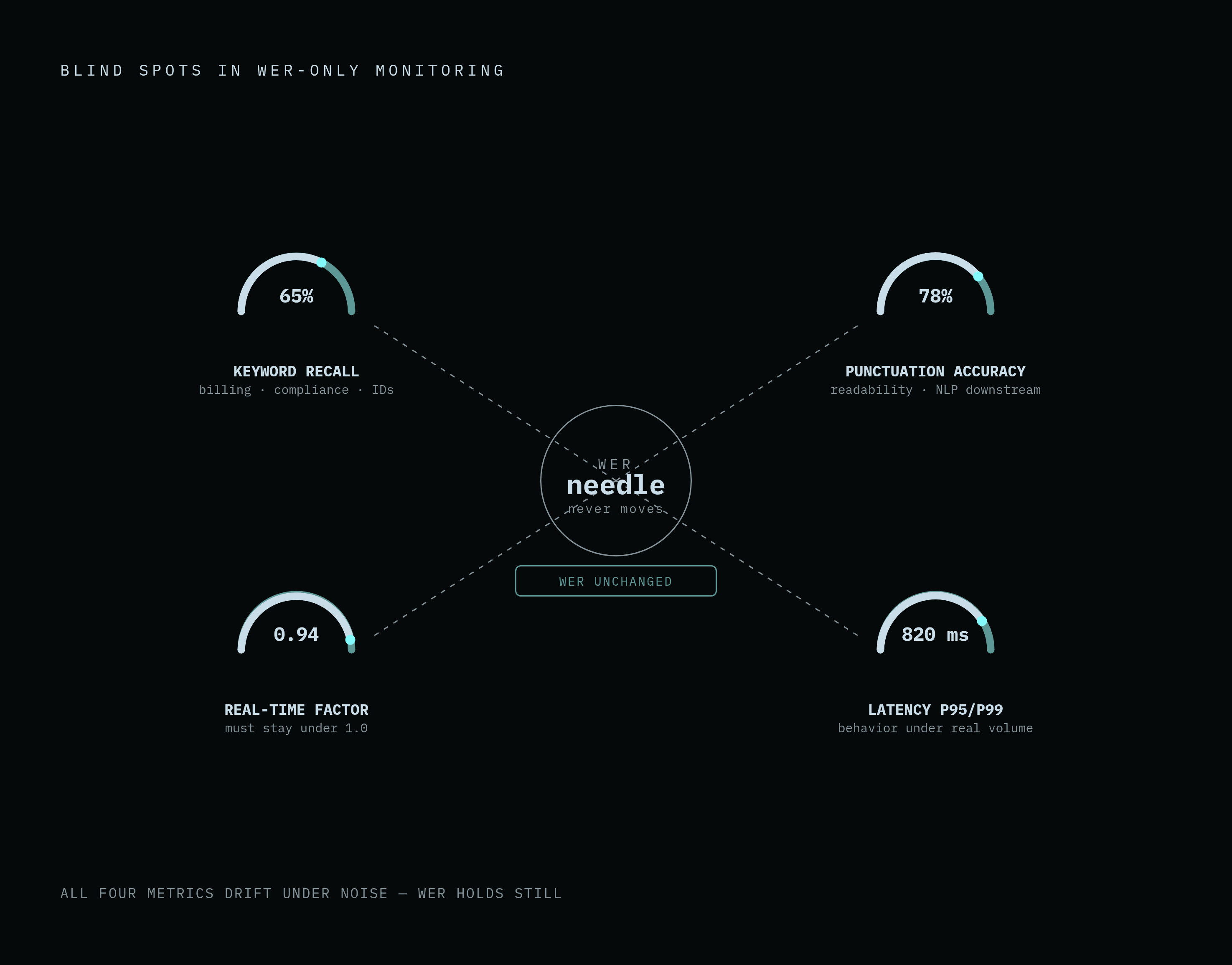
WER still deserves its place. What it calls for instead is a fuller dashboard, with more gauges beside the existing needle. Tracking specific terms like billing events, compliance flags, and account numbers requires keyword recall rate. Punctuation mistakes shape transcript readability and determine how smoothly text feeds downstream NLP pipelines. A streaming application only works if its Real-time factor stays under 1.0. Examining latency at both the 95th and 99th percentiles shows whether a system can handle real call volume. All four of these measures move independently of WER when noisy conditions are present, so a team tracking WER alone will never see them change.
Constructing a Test Set That Reflects Your Actual Deployment Conditions
Taken together, the benchmark mismatch, compositional real noise, and what WER misses leave one clear practical takeaway. A test set should be drawn from the deployment environment that it needs to predict, instead of being assembled from any generic corpus that happens to be on hand.
Pull the test set from actual production audio. Pull clips from real call recordings and mark them up so they cover the field's working vocabulary, the entity categories such as names and account numbers along with dates and monetary amounts, and the speaker transitions that actually arise in deployment. Hand-done transcription with keyword tags and speaker flags produces a ground truth fitted to how the system actually runs in production, not to a generic passage.
Group your evaluation data according to the SNR levels encountered in real use instead of assuming even coverage or the harshest scenario. In telephony, field, and contact center deployments, that spread runs from 5-30 dB. Measuring performance at fixed intervals throughout this band reveals how errors evolve rather than hiding them behind a single overall score.
Stratify on speaker traits without using noise level. Pronunciation mix, caller age, and tempo do not respond to noisy conditions the same way. Weighting those traits to match their production-traffic prevalence keeps aggregate test accuracy aligned with the real distribution of call volume.
Make the test design cover every stage of audio capture. Exercise the device denoiser in both states and use the production telephony codecs, since double denoising shows up only when the full suppressor pipeline is in place.
Track keyword recall on its own, not inside overall WER. When domain-critical terms set off downstream actions, like compliance flags, billing events, or escalation keywords, they carry operational weight that ordinary WER cannot capture, since WER counts every word the same regardless of what goes wrong downstream when that specific word gets missed.
A test set made this way sets the limit on what the whole evaluation can find afterward. Failures become visible only when they match what the test set is designed to reveal, which makes this step’s quality decide the worth of everything that comes after it.
Running the noise robustness evaluation: SNR sweeps, compositional conditions, and hallucination probes
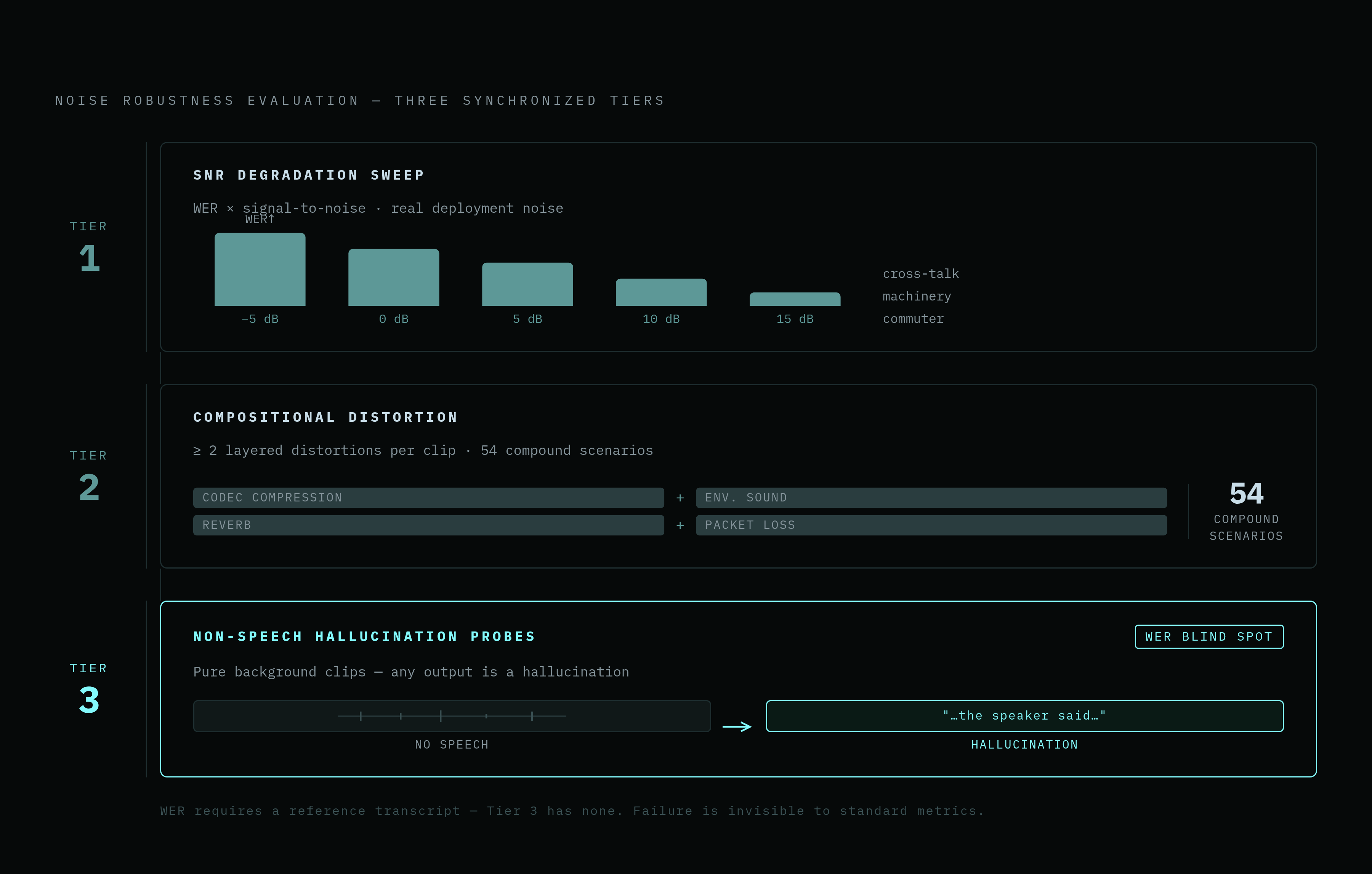
Once evaluation data mirrors real-world conditions, assessment demands three synchronized tiers: SNR degradation curves alongside compositional distortion scenarios plus explicit non-speech probes. Each tier reveals distinct breakdowns the rest overlook, ensuring none of the previously outlined mechanisms slip through undetected.
Begin with an SNR sweep over the real noise conditions expected in deployment. Compute WER for each SNR setting, including 0 dB, −5 dB, 5 dB, 15 dB, and 10 dB, with noise captured from deployment environments, including contact center cross-talk, machinery, and commuter chatter. Skip white noise in this test: it can overstate WER and does not reflect the way real production noise behaves. Chart degradation across the entire curve. A graph of WER versus SNR reveals if performance declines steadily along an expected gradient or drops off a cliff all at once. Such abrupt failures pose greater operational risk than consistently elevated but gradual curves, since everything appears normal until it suddenly breaks. To verify generalization across noise types, this layer must evaluate at least two distinct acoustic conditions, because models often excel with familiar interference yet collapse under unfamiliar signals at identical SNR levels.
This next stage evaluates compound warping, extending the logic behind the prior audio analysis. In real-world captures, signal loss, echoes, and room reflections rarely appear alone. Every evaluation must layer a minimum of two distinct sound distortions together. VOICES-IN-THE-WILD-2M catalogs 54 such compound scenarios, offering a classification of acoustically realistic pairings like distant-source transmission combined with reverberation to mimic church interiors. That taxonomy keeps test design grounded in real acoustic physics instead of arbitrary pairings invented for convenience. When targeting telephony systems, include codec compression alongside environmental sound, since restricting bandwidth to 8 kHz creates unpredictable interference with surrounding noise that neither element produces independently.
The third layer goes straight at behavior on clips with no speech and at hallucination. Drop in clips that contain nothing but background sound, from sudden bursts of noise to the steady drone of an HVAC system. Look at whatever the model puts out in response. By definition, anything the model emits on these clips is a hallucination, and the rate at which it does so on non-speech clips is a robustness measure WER alone cannot deliver. Track speech-voice misfires apart from typical substitution slips in clips where speech exists yet arrives badly degraded, since a fluent but entirely off-target reply triggers different downstream fallout than a mangled word. A bogus account number given with confidence is a different operational risk than a mangled word, even when both would register as "errors" in a simple tally.
All three layers must share the same instrumentation. Run WER computation through NIST SCLITE so scoring stays consistent across vendors and conditions. Rather than relying on averages that conceal tail spikes, record P50, P95, and P99 latency to reveal if a streaming system maintains a real-time factor under 1.0 when loaded. When word-level confidence scores are provided, evaluate them independently, because how well predicted certainty tracks true accuracy amid noise constitutes its own robustness measure. And load-test the whole stack, not just ASR inference by itself. Distributed setups that decouple denoising from the recognition engine add per-hop latency invisible to isolated requests but exposed under concurrent production traffic.
The preprocessing decision and its hidden costs for noise robustness
Preprocessing the audio may look like the obvious thing to do before recognition, but testing often shows that assumption fails unless it is compared with the other path. The usual first move is to put denoising before recognition, but in practice that default is often the one a proper comparison rejects. Trying to make the cleaner track stronger can strip out speech details the recognizer relies on. Speech melody, intonation changes, formant shifts, and brief pauses between words often overlap spectrally with broadband noise, leaving standard filters without a clean way to separate them. Pushing filtration hard enough to cut noise substantially can also smear the recognition cues the model needs.
Denoisers sometimes imprint fresh musical noise artifacts onto the audio. Further along, a compressor can clip the peaks of the signal. By the time the audio arrives at the ASR model, it is decoding speech mixed with the accumulated artifacts of every stage that came before. A unified model learning straight from noisy audio avoids that two-stage buildup of errors, because it never has to work through artifacts left by preprocessing layered over the source signal.
Deciding on an extra preprocessing stage should follow from running the aforementioned layered evaluation both with and without it, not from assuming audio cleanup is always beneficial. The previously noted risk of redundant noise reduction shows this best: a filter appearing helpful alone may interact with suppression already applied by the OS or hardware, eliminating more phonemic detail than either process would discard independently. Evaluating the entire signal chain, preprocessing included, remains the sole method for determining which result truly occurs within a particular deployment.
Methodology & sources
- Mega-ASR: Towards In-the-wild2 Speech Recognition
Provided data on Whisper hallucination rates, training data leakage concerns, and real-world noise behavior that the article draws on throughout its critique of WER and benchmark reliability.