Speaker Diarization Accuracy in Real-Time Conversational Voice Systems
Real-time diarization needs better metrics than DER to match what users actually see.
How DER is calculated
Speaker diarization answers "who spoke when" in an audio stream. It seems easy until the audio must be processed in real time, during the conversation, without knowing how a sentence ends before figuring out who said it. That need to do diarization as audio happens, not after the full file, sorts tools that work in customer support or AI assistants from those built for lab tests.
Diarization isn't a small extra stuck onto transcription. Those tools only work when each line is assigned to the correct person. A word-perfect transcript means nothing if the wrong person gets the credit. A single misattributed speaker in a call center isn’t a little error. It can affect downstream analytics, and at scale, that single mistake shows up repeatedly in thousands of conversations.
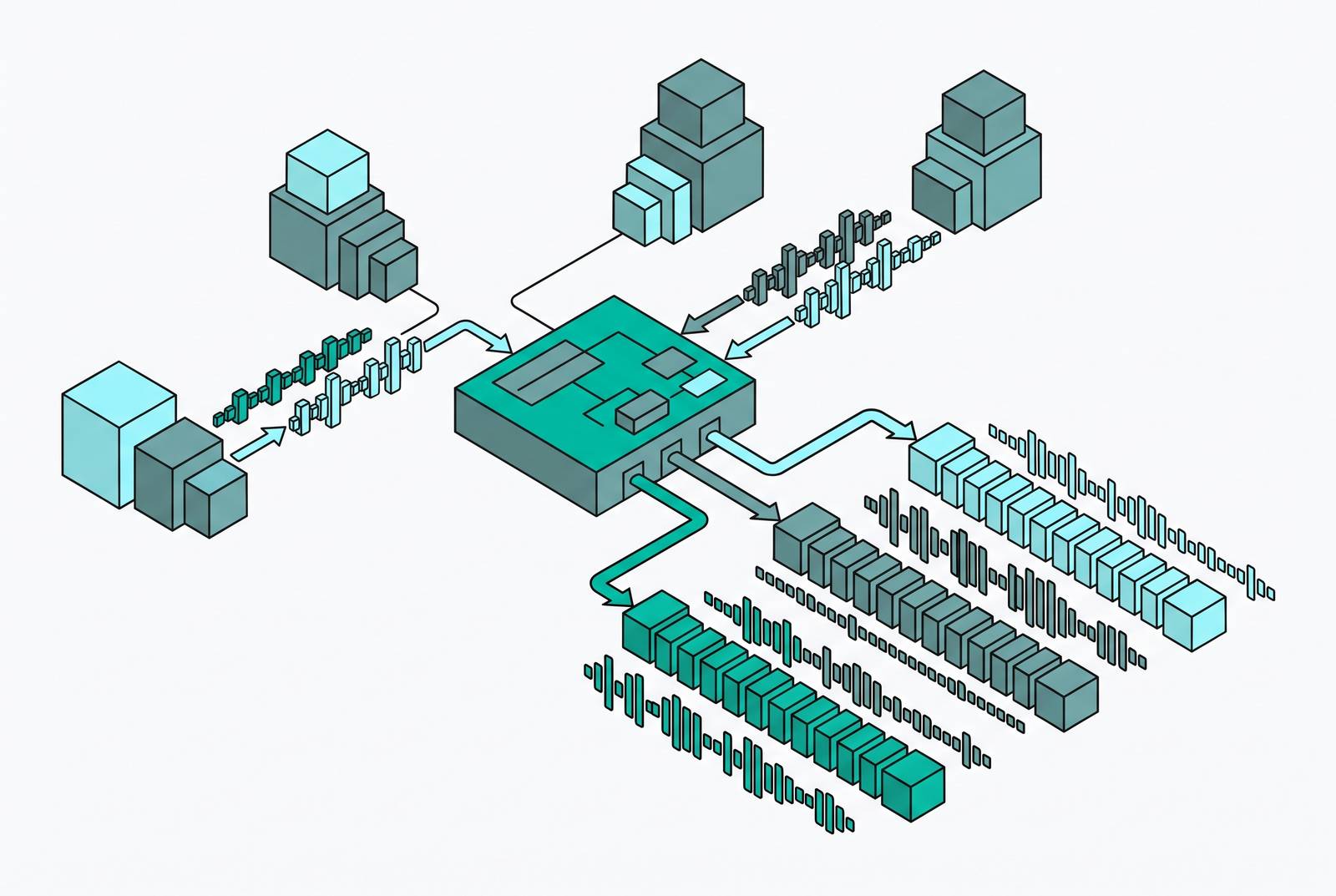
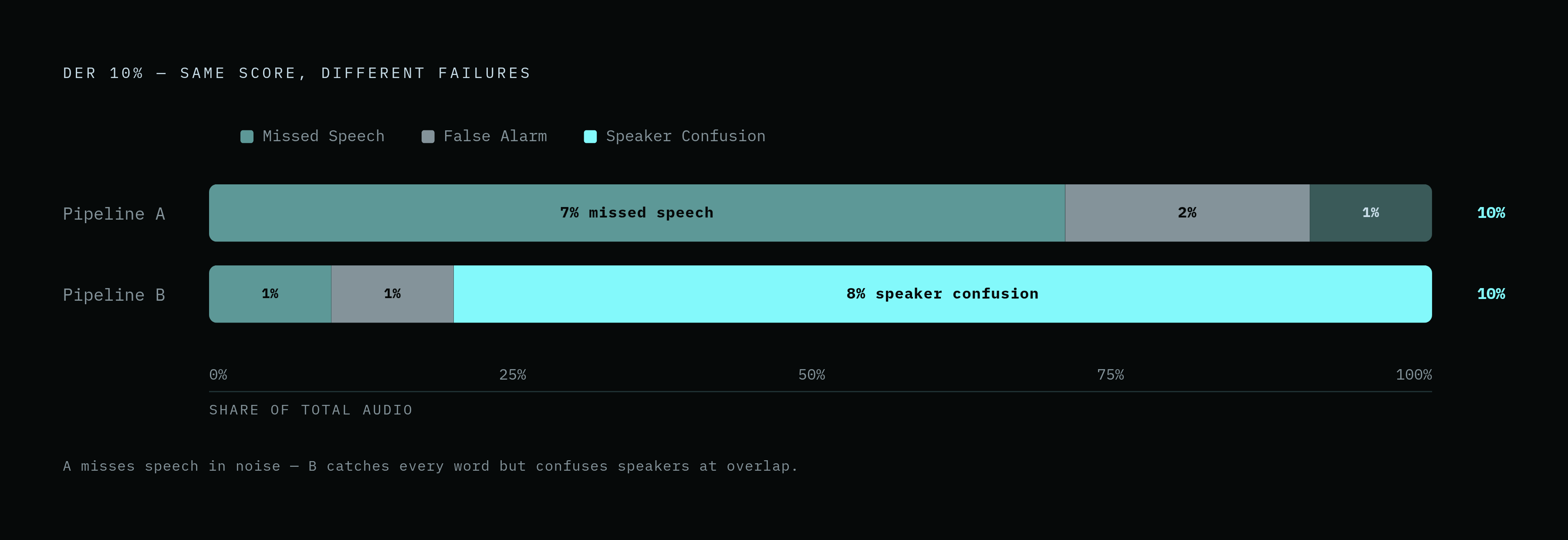
The common yardstick, Diarization Error Rate or DER, combines three error types into a single number. Speech is lost when a person speaks and it isn't picked up. False alarm is the flip side: the model labels a stretch as talking when it's only background. Speaker confusion means the system finds the speech but pins it on a wrong person. With DER of 10%, one-tenth of speech time is in the three buckets, and the mistake is quitting there. Here lies the mistake: one single number can't tell anyone which of these three failure modes they're actually hitting in their audio, since each wrecks a different downstream feature. One number alone won't show which of those three failure modes will actually show up in their audio, and each one damages a different downstream feature.
Both pipelines can score 10% DER yet break in different ways. One might fail to catch speech in noisy stretches. Another might catch every word but mix up who is talking during overlap. The single score flattens that gap, so a team choosing a vendor by the number is choosing blind.
Beyond DER, other metrics cover what it misses. The Jaccard Error Rate, or JER, weights every speaker the same regardless of how much they say. That matters when a single person dominates a call, since DER would give credit for getting only that one person. WDER tests attribution within individual words of the completed transcript, matching what someone actually views. cpWER merges speaker-attribution mistakes with word-recognition ones inside one single calculation of word-error-rate, so it's the go-to metric for pipelines that tackle transcription alongside diarization together.
cpWER should matter most because it shows what someone sees: one transcript with its labels and one number. DER can look fine even while the transcript people actually work with comes out riddled with mislabeled segments. A team that watches just one metric should pick cpWER.
What shifts when diarization has to happen in real time
Diarization can use the full audio before it makes any decision. It can listen to the end of a sentence, check it against the start, revise a label if the evidence changes ten seconds later. So it works well for things like call reviews and meeting notes: no one needs the result right away, and the system can take in the full recording.
Streaming diarization has no such option. It must lock in a speaker label based purely on whatever audio has come in so far, and it can never go back once new audio shows up. So the opening moments of a conversation are where accuracy is worst, since the system hasn't heard enough yet to lock onto a clear voiceprint. Extra context produces stronger speaker matches, while cutting it short speeds up the reply, so every real-time setup negotiates that tension. Every design makes that compromise. If they say it's different, they're pushing a benchmark.
People often miss how the diarization system is rarely the slowest step in that pipeline. Turn detection.
Turn detection as the hidden bottleneck in real-time diarization pipelines
Turn detection, also known as end-of-turn or endpointing, sets when the diarizer is actually given its slice of audio. If that call lags or comes in wrong, then the diarizer inherits noisy edges no matter how strong the speaker system underneath. A diarizer handling poorly-timed chunks behaves as a fine motor bolted onto a bent axle: no tuning downstream fixes a boundary set wrong from the start.
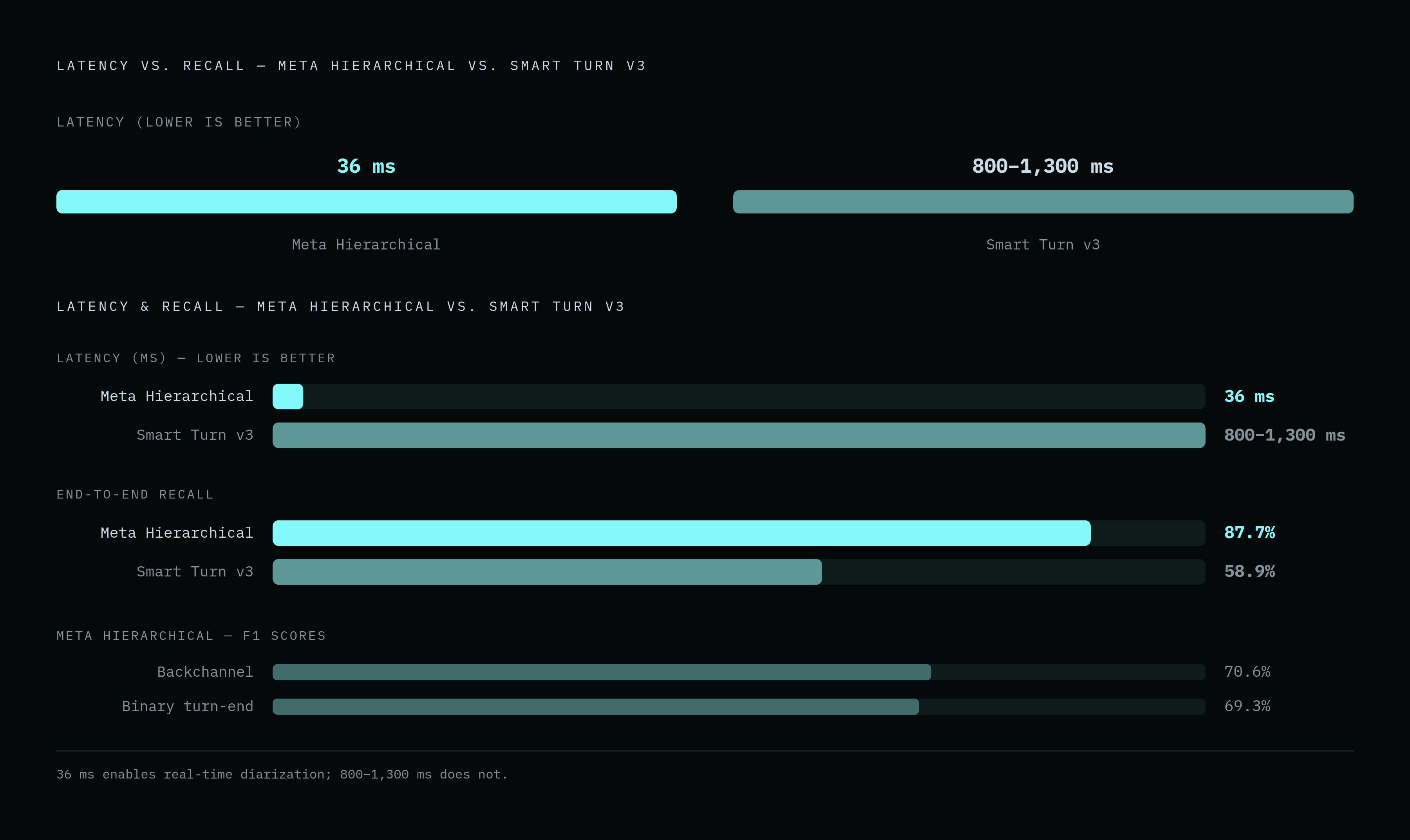
Meta's hierarchical end-of-turn system reveals just how challenging this task can be to get right. It combines speaker segmentation with a detector for hierarchical end-of-turn cues, designed around real-time two-speaker conversation, scoring 82% multi-class frame-level F1 alongside 70.6% F1 when detecting backchannels and 69.3% F1 on the binary job of distinguishing a true turn-end from other speech. In the end-to-end turn-detection benchmark, its 87.7% recall beat Smart Turn v3's 58.9%. The latency is what matters most here: detection takes 36 milliseconds on average, versus 800 to 1,300 milliseconds with Smart Turn v3, so it reacts significantly faster. At a small fraction of the size of typical models, it fits on local devices.
Getting there required satisfying constraints that work against each other. It must stay causal, never using look-ahead on upcoming audio. It has to hold up when a background speaker or stray noise crosses the mic, and it can't lean on keyword spotting as a crutch. It also has to guess near-future outcomes across 10, 20, and 30 millisecond horizons, looking ahead instead of just reacting after the fact.
Backchannels are what break models that look fine in testing. A short "mm-hmm", sometimes "uh-huh", is the listener showing they're paying attention, not handing over control. If a program treats it as a turn stop, it manufactures a false boundary, and that same false boundary turns into a speaker confusion error once the downstream diarizer sees it. Benchmarks that ignore backchannels always miss this failure, so they continue producing systems that stumble on any real conversation.
Overlapping speech, noise, and the conditions that cause benchmark numbers to stop predicting production outcomes
The old method, Clustering-based diarization, is known to struggle when audio has overlapping speech, noise, or speaker variability, and piles up detection misses there. Most real audio overlaps by default, and pushing it to the edge case is how a benchmark loses its hold on production. That's the default condition in most real audio, so acting like it rarely happens is how a benchmark stops matching production.
Real-world production audio involves far-field microphones, background noise plus overlapping speech, mismatches across hardware, an unknown speaker count, and accents a controlled recording never encounters. These problems don't smooth out cleanly. It compounds: when background noise and overlap each cost two points, the result isn't one tidy four-point drop. The combined hit is frequently larger, since those issues compound instead of adding up.
Benchmark numbers turn stale in production because they're checked on clear audio, scripted queries, and staged setups that don't resemble real contact-center call reality, with callers overlapping, going off-script and creating the compliance issues it was meant to catch. Overlapping speech matters most here, since benchmarks routinely exclude it or apply a wide forgiveness collar. This single concession does more to drive up a paper's DER than nearly any other decision. If someone is quoting a benchmark number, ask if overlap was actually counted or ignored to make the number look stronger.
How top diarization tools stack up under stated test conditions
A figure only carries weight when the conditions behind it come along too. If a vendor didn't release numbers from matching tests, admit the gap instead of guessing.
pyannoteAI's Precision-2 posts the best DER across all ten domains in the public benchmark, fully automatic: without oracle voice-activity detection propping it up, without forgiveness collar trimming segments, with overlap counted, not excluded. Across an in-house 250-file set spanning 2 to 10 speakers, it predicts the speaker count 70% of the time, beating the roughly 50% rate from Precision-1. It ships across cloud API, on-premise, and on-device deployment, which matters for a team that wants to start on a free local pipeline and move the same integration into a managed API or a sovereign on-prem setup without rebuilding anything. Precision-2 starts at a €0.096 hourly rate on Starter, with €0.112 for Developer, while open-source Community-1 pipeline inference costs €0.035 hourly. Community-1, running on pyannote.audio 4.0, achieves 17.0% DER (AMI IHM), 19.9% (AMI SDM), and 20.2% (DIHARD 3 full), measured the same way: fully automatic, no-collar, overlap-scored.
AssemblyAI's Universal-3.5 Pro has 30.17 diarization cpWER on a benchmark based on real-world datasets and can handle as many as 20 expected speakers for async with the speakers_expected parameter. Metaview, the meeting-intelligence company, reduced low-confidence tokens by roughly 47% after moving to Universal-3.5 Pro async, a proxy indicating cleaner speaker-attributed results later in the pipeline. It switches between 18 languages on the fly, with Universal-2 offered when wider language support matters most.
For streaming, Universal-3.5 Pro Realtime puts diarization on the transcription WebSocket, and both Universal-3 Pro Streaming and Universal-3.5 Pro Realtime allow 10 speakers through max_speakers. On the Pipecat STT benchmark, which draws on real voice-agent calls, 6.99% WER was reached by Universal-3.5 Pro Realtime versus 15.58% from Deepgram Flux, with cleaner transcription feeding a cleaner input to the diarizer downstream. Hamming.ai tested a large volume of production conversations in its benchmark, where Universal-3 Pro Streaming hit 307ms P50 latency with 8.14% WER while Deepgram Nova-3's 516ms P50 came with 9.87% WER. Costs start at $0.15 for Universal-Streaming and climb to $0.45 for Universal-3 Pro Streaming, plus $0.12 for live diarization, $0.02 for sentiment analysis, and $0.15 for topic detection.
These vendors optimize for different things, so they aren't really rivals. pyannoteAI focuses on easy deployment and holds DER steady across many domains. AssemblyAI leans on the close coupling of transcription pace and diarization in one streaming link. Each metric addresses a different problem. When a team picking between them skips checking the benchmark against its own audio, it can end up with one that performs beautifully for buyers but fails during its opening noisy, overlapping, multi-speaker call it actually faces.