Streaming Voice AI Integration With WebRTC Media Servers
WebRTC's low-latency architecture shapes every downstream choice in voice AI systems.
- Written by
- The Voice Layer Editors
- Published
- October 10, 2026
- Reading time
- 9 min read
- Sources cited
- 1 sources ↓
What this covers
Voice AI systems use WebRTC because the job leaves no real alternative: no other browser-native transport was built from day one to carry live audio with such low delay. Its effects ripple through all downstream choices, including the media server stack and the compliance model.
WebRTC as the default transport layer for voice AI
Which transport protocol a voice AI system settles on shapes its failure modes, and that is why WebRTC prevailed over the rest. WebSocket sits on top of TCP, whose promise of in-order arrival comes from forcing each packet to queue behind the last one. WebRTC flips the bargain: built on UDP, it tolerates losing the occasional packet instead of letting a held-up resend block everything else. For spoken audio, this is the correct bargain to strike.
Bandwidth needs also differ from one transport to the next. Safari did not add support until 2026, and as it stands today it follows WebSocket's lead on media handling rather than defining its own production-ready pattern.
WebRTC is the right foundation not just for what it avoids but for the features it ships with out of the box. Starting with it means no transport migration later.
Media server placement between browser and AI model
WebRTC was made for two browsers to communicate, so a media server has to sit in the middle when a browser talks to a model. A human participant can simply join a peer connection, but an AI agent cannot do the same. The server must close out that link, essentially acting as a robotic counterpart.
That need points to a bigger one. Backend packages such as pion (Go), aiortc (Python's asyncio), and werift were created to surface that unprocessed media cycle.
In day-to-day operation, this role usually belongs to an SFU, short for Selective Forwarding Unit. The SFU judges available throughput, coordinates simulcast layers, and gets traffic across NAT for everyone, sparing the agent from last-mile network volatility. It taps the RTP stream in transit, turns the audio into PCM for the inference pipeline, and also manages recording, telephony bridging or SIP, plus compliance logs, functions that a browser peer connection could not host.
A WebSocket connection carries the signaling phase, which must complete before media can flow. When the signaling completes, voice traffic begins flowing across UDP with SRTP encryption. In deployments today, it lets a system shape an agent's reply during the exchange and return tool-call outcomes to the ongoing conversation.
The five stages where audio travels from microphone to model response
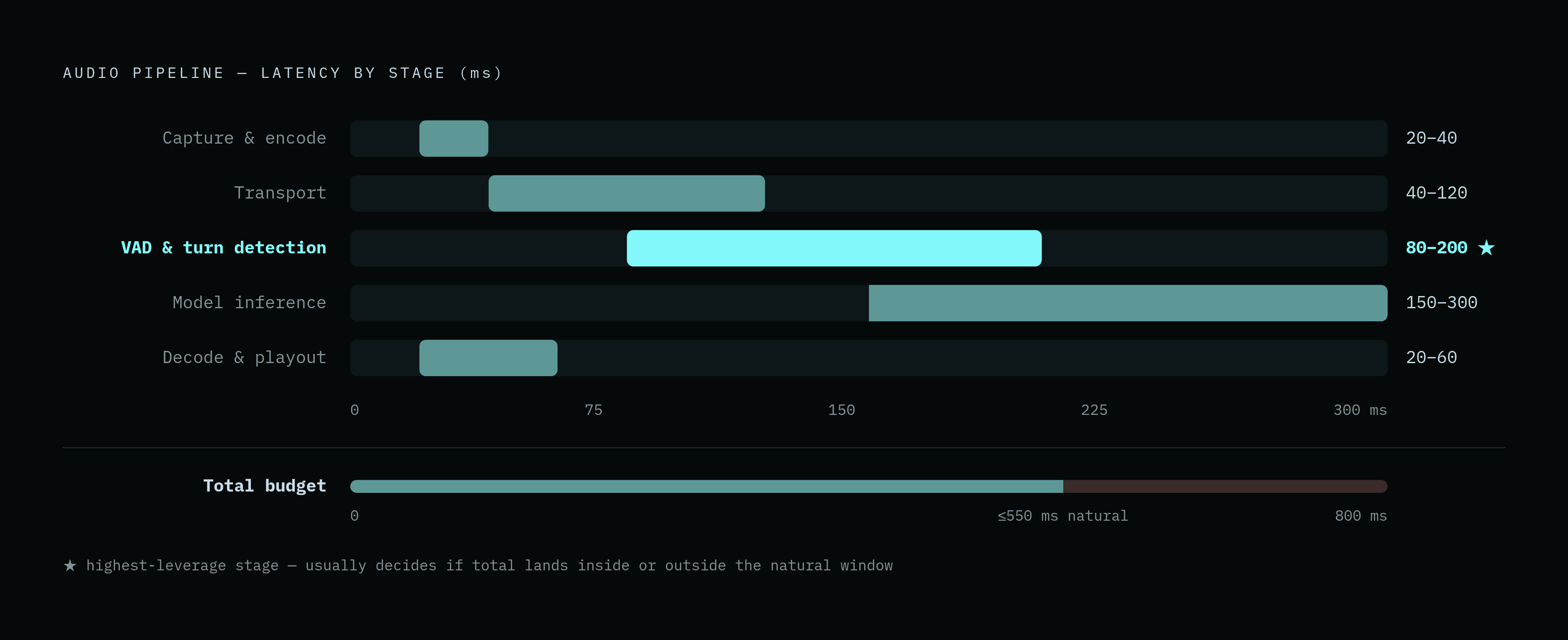
Audio travels through distinct stages from speech to the model's response, and every one carries its own latency limit and its own failure mode.
Audio capture and encoding runs at about 20–40 milliseconds.
Transport is the second stage: it carries the audio from client to SFU, then on to the model's location, a hop that typically costs 40 to 120 milliseconds based on TURN server placement. Where the TURN is located relative to client and model endpoint is by far the largest factor here, and a badly chosen one is a frequent way production systems quietly add latency.
Voice activity and turn detection form the third stage, typically configured in the 80 to 200 millisecond range. A detector set too aggressively makes the agent cut people off, while one set too conservatively leaves the user waiting through dead air, unsure whether anything registered. This one adjustment carries more weight than almost any other when the system goes live.
OpenAI's gpt-realtime-2.1 shows first-token latency of 150 to 300 milliseconds, while the gpt-realtime-2.1-mini brings it under 100 milliseconds.
Last comes decoding and playout, where a jitter buffer keeps the synthesized audio stream smoothed for 20 to 60 milliseconds before it hits the speakers.
Where latency goes and why the conversational threshold is hard to hit
A conversation comes across as natural somewhere in the 500 to 800 milliseconds of end-to-end latency range, but beyond roughly 800 milliseconds, people wind up repeating themselves since they figure the system missed them.
On a phone call, humans notice mouth-to-ear latency after about 150 milliseconds, so voice AI must respect that identical ceiling despite dividing its budget among more steps than traditional telephony ever required. A conversation feels natural below roughly 550 milliseconds. It doesn't above roughly 800.
Voice activity detection, not model inference, usually decides if a system lands inside or outside that window. At sub-1% levels, the VAD was likely set too cautiously to catch actual interruptions.
Teams often tune production systems too late or in the wrong sequence. In most vendor rollouts, WebRTC is left on stock settings rather than shaped around a language model's conversational rhythm, and because LLM turn-taking is not paced like human-to-human dialogue, that out-of-the-box setup still adds avoidable delay.
What each voice loop architecture gives up
Choosing a cascaded speech-to-text, language model, text-to-speech pipeline over a unified speech-to-speech model means sacrificing observability, predictability, and steering, so the choice should match what the agent needs to handle.
In a staged setup, teams can swap the audio recognizer, language model, or speech generator one at a time while the other two stay intact. In 2026, this design remains the standard for most deployed agents, particularly when dependable tool use and step-by-step traceability are important.
With direct audio-to-audio architecture, the three steps become a single service call: sound goes in and sound comes out, with no transcript created in the middle. Cost varies a lot depending on the provider. OpenAI's Realtime model costs roughly twice to three times as much as a comparable chained setup, whereas Amazon Nova Sonic and options such as Gemini 3.1 Flash Live sit nearer that price range, a spread that can reshape return-on-investment calculations at high call volumes.
In practice, production deployments across 2026 have converged on a mix of the two. Tool invocations trigger a fallback to cascaded processing, since monitoring text and ensuring dependable function execution outweigh vocal quality there, with the pipeline reverting to direct audio output upon formulating a response.
WebRTC implementations at OpenAI, AWS, and LiveKit
Three vendors now run the biggest real-world WebRTC voice AI setups, and each put control in a separate place.
In December 2024, OpenAI introduced WebRTC endpoint access for the Realtime API, allowing developers to link a user's browser straight to OpenAI's edge as peers, sending audio via UDP with SRTP protection. Still, choosing that transport on its own will not deliver conversational latency, so careful tuning remains essential.
In May 2026 AWS laid out its own architecture, pairing its unified speech-to-speech model Nova Sonic with Kinesis Video Streams from Amazon, running WebRTC as a fully managed service. A client establishes its WebRTC connection via a signaling channel from Kinesis Video Streams, trading SDP offers and ICE candidates until a bidirectional peer connection is in place. From there, audio and video move over a media channel with adaptive bitrate and DTLS encryption, while text and control messages go over a separate data channel. Nova Sonic handles tool calls, whether to MCP servers, Strands agents, or retrieval-augmented generation, so a speech-to-speech pick doesn't shut out external tool integration. Then in March 2026, Amazon Bedrock AgentCore Runtime gained WebRTC support of its own, letting clients and agents stream to each other in real time in both directions. AWS manages both services end to end and scales them automatically, a good fit for teams that prefer to skip running an SFU themselves.
LiveKit went another way. The Agents framework reached version 1.0 during April 2025, evolving into Python 1.5.x come April 2026 while gaining adaptive interruption handling plus built-in Model Context Protocol tool integration along the way. Its transport relies on Redundant Encoding over WebRTC to recover from errors, and notably omits audio NACK retransmissions altogether, which sets it apart from Google Meet.
Choosing a media server: what the open-source options optimize for
5 open-source WebRTC media server options have held up in production, each shaped by its own constraint, and that matters more for choosing between them than a raw benchmark ever would.
Written in Go with Apache 2.0 licensing, LiveKit is a strong fit for AI agents, online care, education technology, and broad real-time use cases. Teams can rely on mature tooling, with SDKs plus an Agents framework that links WebRTC sessions into AI pipelines and language model work. Fora Soft is a proven build partner for production LiveKit-based voice AI systems across live selling, virtual care, and education technology.
mediasoup ships under ISC for Node.js, C++, and Rust, fitting gaming, edtech, telehealth, spatial audio, or routing.
Written in C and released under GPLv3, Janus combines an SFU core alongside a plugin architecture. Its plugin design makes it ideal for broadcasting, edtech, medical consultations, and linking SIP with telephony systems. Deploying Janus on local infrastructure ensures sound never leaves the managed environment, a critical requirement under rules like HIPAA and the EU AI Act that forbid audio from crossing hospital or enterprise boundaries.
Ant Media Server Community Edition is a Java project under Apache 2.0 that fits huge live broadcasts, converting low-latency WebRTC feeds to HLS or RTMP when too many viewers need a peer connection.
Volume mostly decides whether to run this infrastructure in-house or hand it off to a vendor. Under about two million participant-minutes monthly, a managed SDK such as LiveKit Cloud, Agora, or Daily Bots generally wins because setup takes only days. Once monthly usage passes roughly five million minutes, or compliance rules grow tight enough to force the issue, running open source infrastructure in-house starts paying off, since self-hosted LiveKit or a mediasoup deployment on commodity cloud costs substantially less per minute. Whichever route they take, teams usually get to production sooner by adjusting VAD thresholds, barge-in behavior, and where TURN servers sit, not by building an SFU from the ground up.
Compliance constraints that the pipeline architecture must encode from the start
For HIPAA and the EU AI Act, compliance constraints are not something to bolt onto a completed voice AI pipeline. They must be settled upfront, before the architecture is picked, because they decide which services qualify, where audio may go, and how any in-house backup must be built.
Azure OpenAI covers HIPAA-eligible text use, while audio is treated separately and does not receive the same status automatically. That helps explain why the pipeline that converts speech to text, sends it through a language model, then renders text to speech remains useful despite better direct voice models: any single stage can run in-house or be replaced with another compliant option without tying it to the other two.
Under the EU AI Act, compliance duties arise specifically when a system handles biometric identification or emotion inference. If a voice AI tool does either, teams must document it, include it in the relevant Data Protection Impact Assessment and make sure business associate agreements apply to any AI vendors involved. Teams should build compliance into the design process from the start, mapping the data flow as they create the pipeline, because regulated deployments can no longer leave it until later.
The mapping here is straightforward. For regulated work in medicine, law, or finance, deploy your own SFU such as Janus or the open-source LiveKit edition alongside locally processed or private-cloud models. Projects outside regulated sectors are free to rely on hosted model endpoints and managed WebRTC SDKs. After determining your regulatory status, reevaluate your media server and pipeline design, since compliance may eliminate seemingly viable approaches.
Media over QUIC and the future of the transport layer
This is an architectural constraint. Its impact is far greater in broadcast-like settings, with many listeners simultaneously tuned to one AI-generated audio stream.
Cloudflare's edge now includes MoQ relay infrastructure across over 330 cities. For now, in May 2026 MoQ still needs a clearly defined role not already handled by another technology, and its specification remains months short of IESG submission; RFC publication would follow later. It is worth tracking on the roadmap, not shipping in live service today.
In 2026, multilingual voice AI and WebRTC are already underway on a shared path.
Teams already relying on an SFU with WebRTC still have every option open. Tuning VAD, selecting the voice loop architecture, choosing the media server for the deployment, and designing the data flow for compliance all belong to the AI pipeline. MoQ leaves those choices untouched.
Methodology & sources
- Build real-time voice streaming applications with Amazon Nova Sonic and WebRTC
Provided details on AWS's architecture pairing Nova Sonic with Kinesis Video Streams, including the signaling channel, SDP/ICE negotiation, DTLS encryption, data channel design, and tool-call integration.