Barge-In Detection Methods in Voice AI Assistants
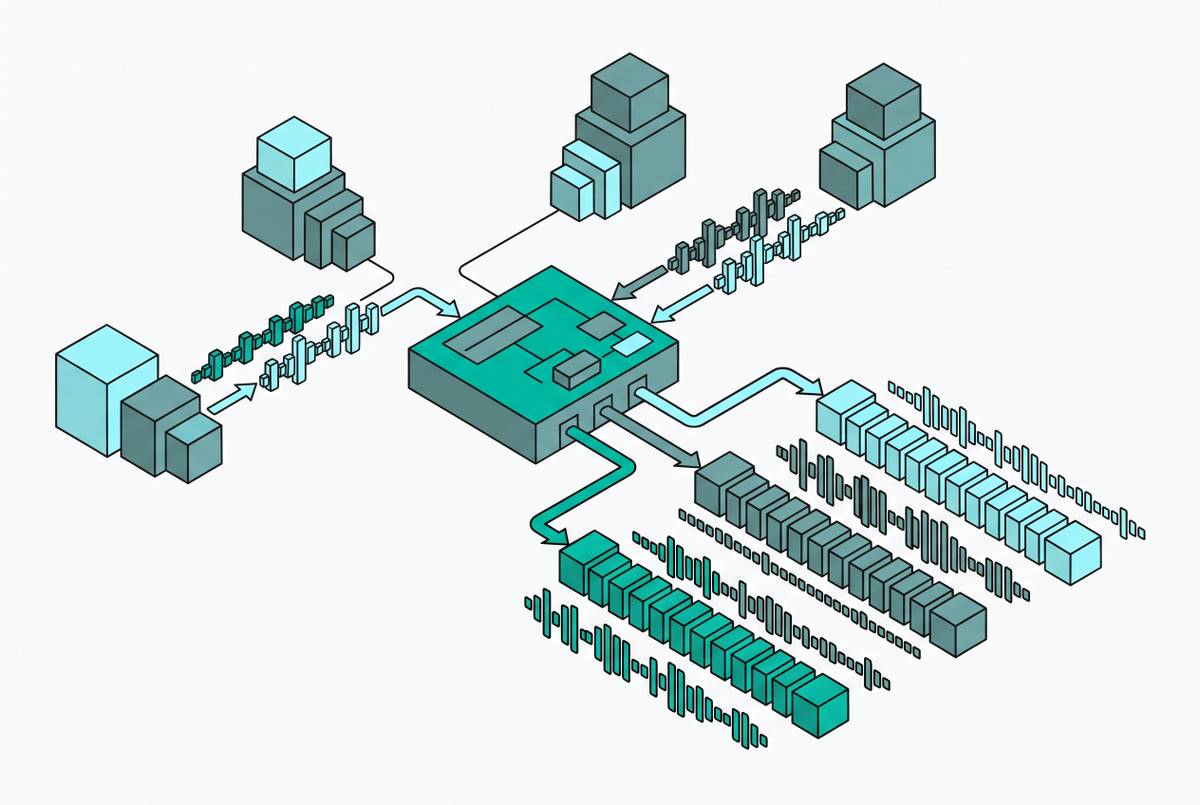
Real-time barge-in requires coordinating five technical stages, each with its own failure mode.
Old IVR systems make callers "speak-and-wait": hear the whole menu, wait for the tone, then talk. Old phone switches needed that rule, and it's worn out. Gnani.ai reports that 60% of customers hang up when made to sit through long prompts, and 75% say traditional IVR flat-out frustrates them. A dev.to writeup goes further, putting the loss of potential customers before they ever hear a real response at 62%. That's a clear revenue loss, not a UX touch-up, but most teams still treat it as design rather than engineering failure. That's the wrong call, and it's why so many "AI voice agents" still sound like an animatronic display arguing with itself.
People forget if the agent answered correctly. What stays with them is the voice that cut them off, brushed them aside, or kept rattling off a menu once they'd already given their answer. Using Siri, Alexa, and Google Assistant every day has changed what people expect from a voice interface, so when a system won't give way, it doesn't look like a technical limit. It feels like a brand failure.
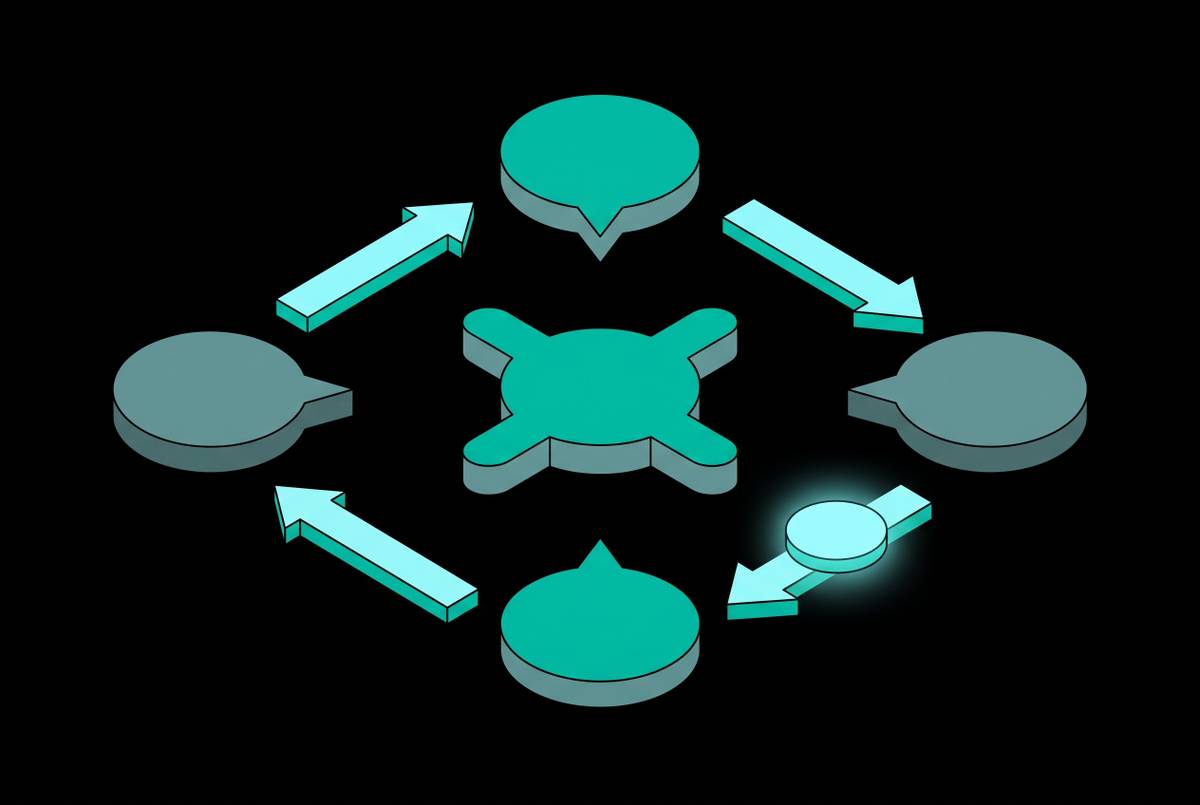
Barge-in fixes it: a caller can interrupt an agent mid-sentence, and the system stops and listens. Most vendors sell it as a single switch you flip on. No, it's not. It's a pipeline with several distinct stages, each with its own way of failing, and miss any one and the illusion of seamless interaction falls apart. Think of it as one feature, and you'll ship something half-working without knowing why.
What barge-in detection actually has to accomplish, technically
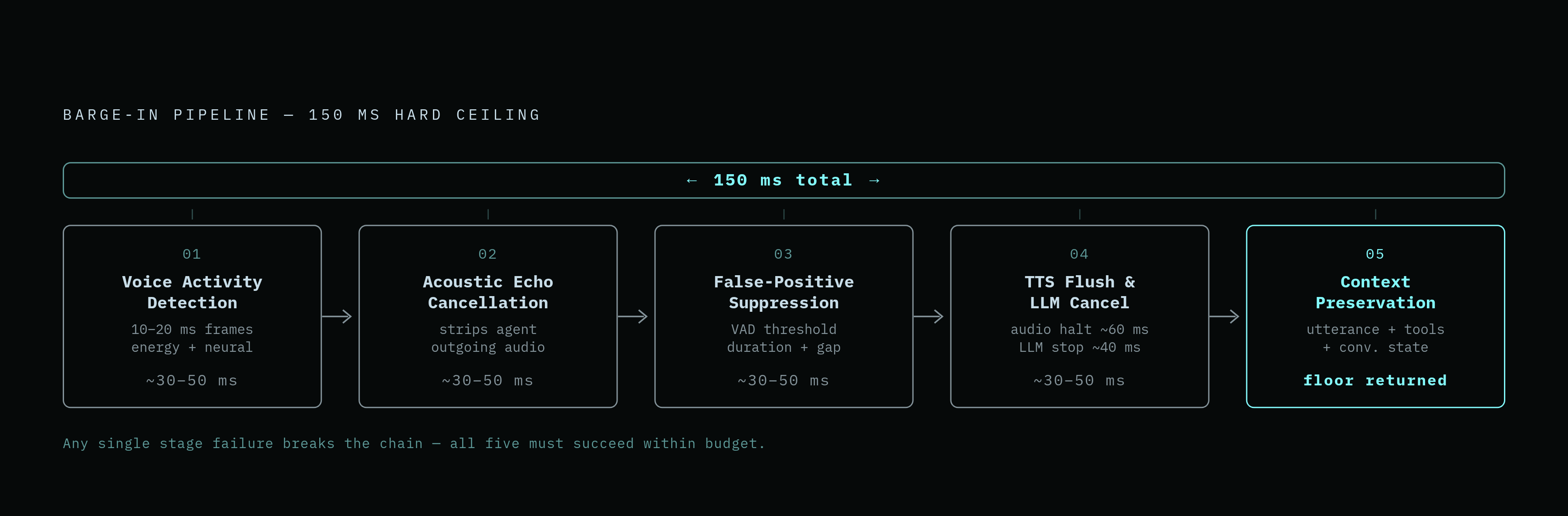
Real-time barge-in means the system keeps listening non-stop, handling speech as it comes in, even mid-output. That's nothing like turn-based dialogue, where the system speaks, goes quiet, and only then starts listening. Three distinct mechanisms must cooperate: voice activity detection (VAD), turn detection, and barge-in cancellation. They seem like one problem phrased three different ways. They're not the same thing, and lumping them together is where most implementations fall apart.
Double-talk, where the user and agent talk at once, is the tough part. It must separate the user's speech from its own echo, judge whether that speech is a genuine interruption or a stray "yeah," and act before the delay becomes audible to a human ear. Everything together, from spotting the barge-in to stopping the audio, canceling the LLM, and handing back the floor, must fit in under 150 milliseconds. Divided among the components, each gets roughly 30 to 50 milliseconds for its part.
Three factors make that budget hard to meet. Real calls don't give you a clean signal: you get hold music, coughing, a TV playing nearby, the background drone of a call center. To a machine, that instant-feeling moment is a tight window where several decisions must run one after another, not at once. And when the interruption hits, state is spread all over: audio in the playback buffer, a language model still mid-token, maybe a tool call halfway through its round-trip.
Next, this piece walks through that pipeline step by step: VAD, the barge-in trigger, TTS flush, LLM cancellation, and context preservation.
Layer one: how voice activity detection decides someone is speaking
VAD processes each frame of incoming audio nonstop, even when the agent's own voice is playing. It doesn't give a yes-or-no. It gives each frame a confidence score, and something later decides how to use it.
Real-world setups usually use three layers. The first is a simple energy threshold: audio under a low dBFS floor is marked silence, audio over a higher floor becomes a candidate for speech. It runs quick and costs little, but it can't separate a person talking from a door slamming or a truck honking.
At this stage a classifier decides whether that candidate audio is a human voice, and that's the spot where most teams slip up by treating all VAD models as swappable, which they aren't. For production, Silero VAD is the best starting choice: it's a compact neural network made for streaming across several languages. It uses little CPU, and its false-positive rate stays in the low single digits even on noisy phone audio. The older GMM-based classifier that ships with the WebRTC stack is faster, yet it stumbles more on music and the low drone of a call-center room. Choosing it just to save money usually means paying more later to fix false barge-ins. Custom CNNs earn their keep only when the audio profile is unusual enough, a heavy regional dialect, a specific kind of background noise, that off-the-shelf classifiers start guessing wrong too often to trust.
The third layer uses a minimum-duration guard. It only triggers after picking up continuous speech for a few hundred milliseconds that clears a confidence bar over several consecutive frames. That's what keeps a cough or a quick "mm-hmm" from triggering a full barge-in. The guard adds a bit of detection lag, yet false barge-ins fall so much that it always pays off. Frames need processing about every 10 to 20 milliseconds to keep the full chain under 100 milliseconds end to end, and the neural classifiers handling it are designed around that timing.
A false barge-in is a worse failure than a slightly slow one, full stop. The entire stack should be deliberately tuned to err on the cautious side, and any team chasing detection speed over false-positive rate has its priorities wrong. You see it in call quality during the first week of production traffic, and by then callers’ trust is already damaged.
VAD on its own is still what most production systems use, but it's now the legacy half of a two-track field, and relying on it alone over time is a mistake. Dedicated turn-taking models like LiveKit's TurnDetector learn to classify backchannel, barge-in, and silence rather than rely on an energy threshold. VAD on its own can't handle "uh-huh." That sound isn't silence, and it isn't a true interruption either; treating it as either one gets the wrong result. The real ceiling is a turn-taking model trained directly on that difference. Teams still leaning on threshold-only VAD in 2025 are tuning a part that's already on its way out.
Layer two: acoustic echo cancellation and the double-talk problem
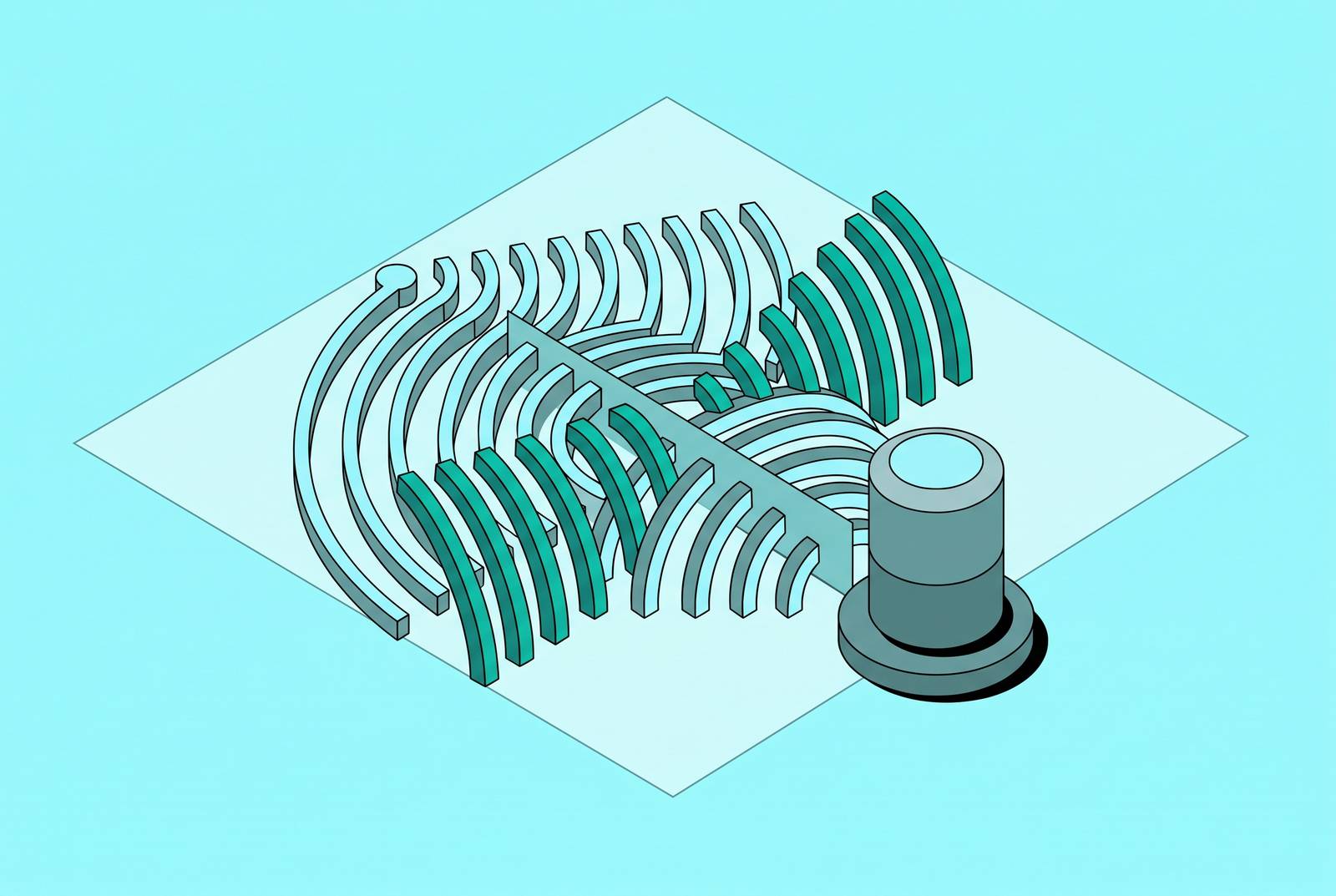
The agent's outgoing audio comes back in through the caller's mic. That's how phone calls work. Without correction, a VAD classifier treats that leaked audio like caller speech, so the system triggers barge-in on its own voice.
AEC removes the agent's outgoing audio from the return feed, leaving VAD with just the caller's voice. Double-talk means both sides are talking at once, and AEC has to strip the echo without damaging the caller's actual voice. It's a real signal-separation challenge, not a simple tweak, and most implementations fail by treating it as the latter.
The usual failure is false suppression, when AEC treats the caller's live voice as echo and wipes it out with the leak. Push AEC too hard, as most teams tend to do, and that's exactly what happens. The system wipes out what the customer says along with the agent's leak, so barge-in breaks even when VAD works fine.
A concrete caveat for web audio work: Firefox's WebRTC AEC trails what Chrome and Safari offer. Firefox users get more echo artifacts than Chrome or Safari users, and any setup that can't pick the caller's browser has to plan for that gap instead of assuming everything matches.
AEC should come first in the pipeline, not be added later. The VAD classifier in Layer 1 can only be as good as its input signal, so without echo cancellation first, VAD runs on bad data no matter how well it's tuned. Mix up the order and every later fix just hides a bad input.
Layer three: suppressing false positives without killing responsiveness
Threshold tuning is a real trade-off, not a set-and-forget knob. Set it too low and the agent cuts itself off on background noise, on filler words, on the prosodic dip in its own voice that marks the end of a sentence. Set it too high, and barge-in feels sluggish: callers end up raising their voice or repeating themselves just to get a response.
You tune three things: the VAD energy threshold, how long someone has to talk before a barge-in registers, and the gap between spotting it and stopping synthesis. They aren’t single sliders, nor can synthetic test recordings be used to tune them. Lab recordings lack the noise of an actual phone network, actual background sounds, actual caller behavior, so tuning on anything except production call audio tunes for the wrong problem entirely. A 2024 enterprise case study from sparkco.ai showed that switching to duplex processing and improving AEC dropped false positives by 30%.
Run detection inside the model rather than depending on a client-side VAD pass. It’s the better path, and it’s where the field is really headed, no matter what either side’s marketing says. Client-side VAD fires on any audio energy, so background noise, a television, a door closing, all trigger false positives. Deepgram Flux handles this inside the model. It grasps what's actually being said instead of merely gauging energy, and its StartOfTurn and EndOfTurn events come from its own turn detection, not a bolted-on VAD stage. Every Flux StartOfTurn event comes with a non-empty transcript, blocking the usual false trigger from silence or stray noise. The tradeoff is slightly higher latency, because the model waits for enough audio to confirm real speech before committing. When there's a lot of background noise, that tradeoff almost always makes sense.
Some systems add an LLM over threshold tuning to decide if an interruption makes semantic sense, giving context the raw signal lacks. Consider it a helper, not a replacement. Teams make a mistake when they use it instead of proper threshold work because they'd rather patch the symptom than fix the pipeline. Once a system is live, grouping failures by kind, false barge-in on background noise, a slow TTS flush tied to one specific provider, repeated barge-in on one particular intent, is what makes post-deployment tuning possible at all. Without that clustering, single failures get lost in a sea of raw call logs.
Layer four: stopping audio and preserving state when a barge-in fires
When barge-in triggers, the timer starts over. Audio must halt in about 60 milliseconds, and anything slower makes the caller feel the agent just didn't notice them speaking.
Reaching it needs a TTS provider made for mid-stream cancellation, and this actually separates vendors, not just a spec-sheet note. Cartesia Sonic and ElevenLabs Turbo support mid-stream cancellation via WebSocket close. PlayHT and OpenAI's TTS handle this inconsistently, so confirm it before picking a vendor, since the gap appears right when barge-in counts most. Once the cancellation signal fires, the audio buffer must empty and the playback device must settle back into listening mode cleanly, not mid-word.
The LLM writing the response must stop too, usually in roughly 40 milliseconds, and its partial output gets tossed or kept according to the system's policy.
Context preservation is what most teams shortchange, and it decides whether the system feels coherent or amnesiac. You need to capture the interrupted utterance, any tool call that was mid-execution, and the conversation’s overall state so the next turn can resume from where things actually stood. Skip it, and the agent repeats itself next turn or loses the thread completely, and either one sounds broken to the caller. You also have to deal directly with any tool call that gets cut off mid-execution. Dropping it without a word leaves later behavior inconsistent in ways you can almost never trace back to why.
Don't rely on a cloud STT provider to spot the barge-in itself. It's a frequent design error in this pipeline, but simple to skip: STT is just too slow for a 150-millisecond window. Run a fast, local VAD model, Silero is still the right pick, right on the echo-cancelled audio so the interruption fires instantly, and leave the transcript to STT as a separate, slower task.
This basic design approach is older than most people realize. Google's patent US 9,922,645 describes a system that takes in a combined signal with both the speaker's output and other audio, runs it through a model trained to spot that output, and treats whatever's left as user speech, then turns down its own output. US 11,942,083 later adds a dialog manager over that layer that detects a barge-in and turns off or lowers the speaker device once it identifies the additional signal. This is real signal separation, not a threshold guess.
How platform architecture choices shape barge-in behavior end to end
There are two main architectures for this, and picking one over the other matters. The modular approach, chaining speech-to-text, a language model, and text-to-speech, treats each stage as its own piece, so cancellation signals must be passed across every boundary between them. Building and running it costs less, yet the coordination overhead introduces latency at each seam. Teams that choose it only to save money often spend months later fixing those seams, and the planned savings vanish once someone is paid to debug them.
Speech-to-speech (S2S) architecture folds everything into one model that turns audio straight into audio, skipping the text step entirely. For anything latency-sensitive, it's the better choice, period. OpenAI's Realtime API scaled this up from October 2024, relying on server-side VAD with an adjustable threshold. Drop the threshold too far and false positives spike quickly (a cleared throat reads as speech), so production teams tune it by hand instead of trusting the default.
Google's Gemini 3.1 Flash Live takes in audio, images, video, and text and puts out audio and text, covering over 70 languages, representing the broadest native language coverage of any speech-to-speech system. It handles natural interruptions mid-response with approximately 400ms end-to-end latency in production configurations. Kyutai's Moshi, an open-source, full-duplex speech-text model, reaches roughly 200 milliseconds via the Mimi codec, the lowest latency figure among the systems named here. Inworld AI layers semantic VAD over Silero VAD and a Smart Turn detector you can tune for eagerness, offers a basic energy-based VAD too, and manages barge-in automatically via an interrupt_response setting that recovers cleanly. Come May 2026, it takes images as well as audio within a single session, so visual context feeds into what it reasons about.
Money matters just as much as latency in these choices, and the tipping point hits faster than most teams expect. According to forasoft.com, under roughly 10,000 minutes a month, Vapi or Retell costs less after comparing platform fees with not running your own infrastructure. Above that volume, building straight on OpenAI's Realtime API and LiveKit Agents costs less since it cuts out the platform fees completely. At that scale, barge-in architecture and cost architecture are the same decision. It's one call made from two directions, and teams that choose on latency alone, skipping the cost math, end up migrating twice: once for the bill, once for the mess the first move left behind.
Don't ship any of it untested. You can spot a bad threshold before real callers hit it by running barge-in rules through persona simulation: 18 built-in personas plus unlimited custom ones, letting you adjust gender, age, location, accent, and background noise.
What separates voice assistants that feel natural from those that feel robotic
A failure in any of the five stages shows up as a symptom all its own, and together they shape what the caller hears. When VAD is miscalibrated, the agent fires on noise or, just as often, misses actual speech completely. AEC set too aggressively mutes the caller's voice during double-talk. Missing false-positive suppression means the agent cuts off its own sentences over a stray "mm-hmm." Lost context means the agent repeats itself or loses the thread after an interruption. When latency runs too high, the agent seems to ignore the caller until it finally stops talking.
By 2025, callers expect responses under 100 milliseconds, and anything slower feels broken rather than just delayed. According to sparkco.ai, a company that got VAD response below 100 milliseconds saw real improvements in user satisfaction. Barge-in isn't something you tack onto a voice agent later. It's five stacked engineering problems that can each break on their own, and getting only four right still leaves a system that feels broken. It needs all five, or callers notice, and once they do, they don't come back to explain why.