Audio Chunking Strategies for Low-Latency TTS Pipelines
Chunking text before synthesis determines responsiveness more than model speed ever will.
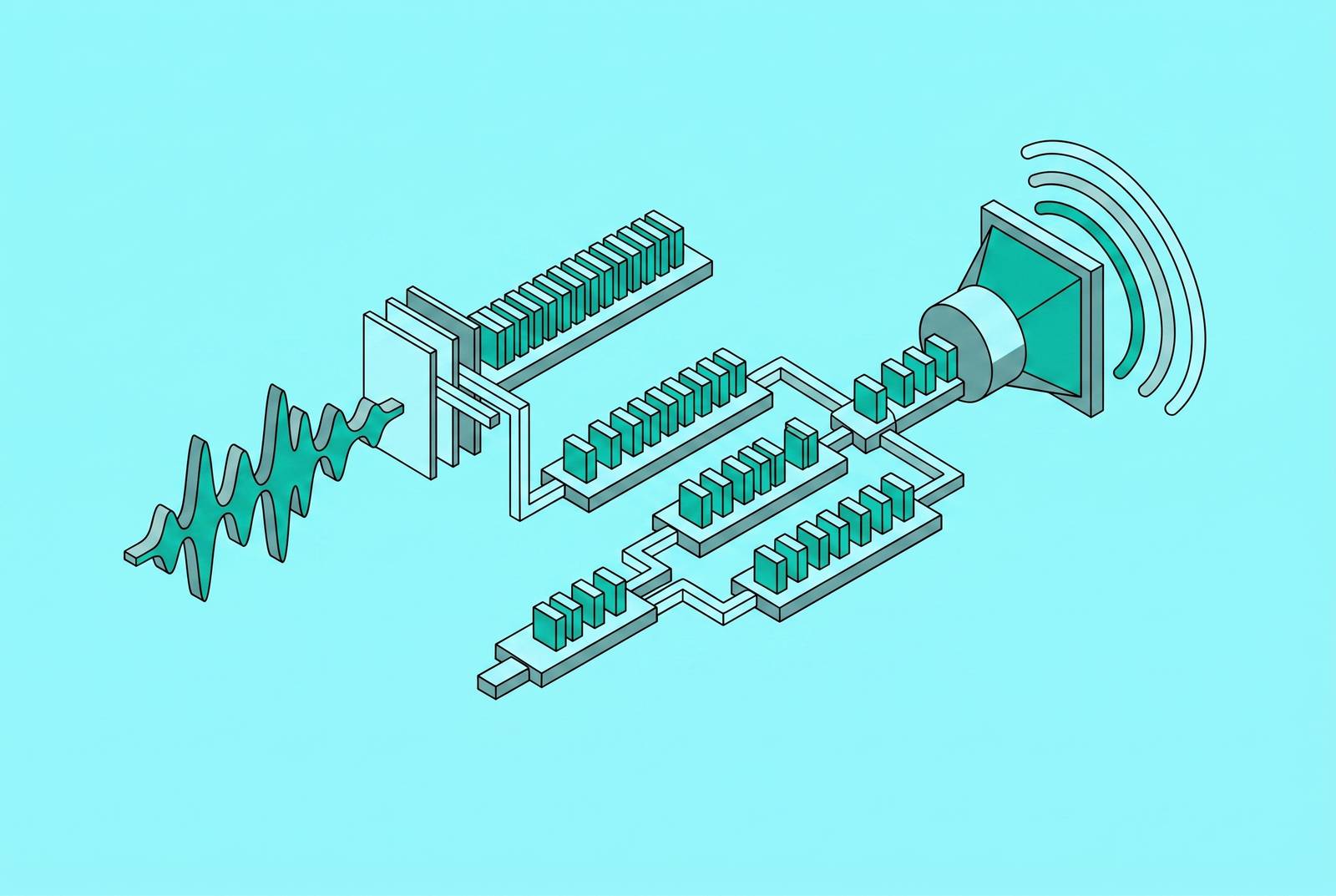
Time to first audio, or TTFA, is the metric that decides whether a voice AI feels alive or feels like a phone tree from 2003. This piece is about the one lever that moves TTFA more than any model benchmark ever will: how text gets cut into pieces before it hits the synthesizer, and when those pieces get sent. Get the chunking wrong, and it does not matter whose model is running underneath; the conversation already sounds like it is on hold.
TTFA is a distinct measurement from total synthesis time, and it differs from TTFB too. TTFB can fire the moment a server sends back empty container headers, which tells a client nothing about whether a human voice is about to come out of the speaker. TTFA is the elapsed time from request to the first playable sample: a number about how a response feels, measured separately from how fast a pipe moves data. That gap matters because engineers default to optimizing throughput, while the person on the other end of a customer service call is judging responsiveness, and those are not the same job.
The stakes are not made up. ITU-T G.114 sets 150 milliseconds as the target for natural conversational flow, with 300 milliseconds as the outer edge of what still feels acceptable. Stack a full voice pipeline, speech-to-text feeding an LLM feeding text-to-speech, and the delays pile up until the practical target for the whole round trip lands somewhere around 500 to 800 milliseconds. TTS synthesis alone can eat 75 to 300 milliseconds depending on the model and setup, so the TTS stage by itself can burn through the entire conversational budget if nobody is watching it. Model speed matters. But how and when text arrives at the synthesizer matters more, and unlike model speed, that part is actually in a practitioner's hands.
Where chunking actually sits in the latency budget
Trace the pipeline in order: the LLM emits tokens, those tokens get buffered and chunked, a chunk goes to the TTS engine, synthesis starts, and the first audio frame comes back. Simple enough on paper. Here is the detail that trips people up: synthesis cannot start until that first chunk goes out the door, so the chunking decision does not just shape how long synthesis takes. It decides when the synthesis clock even starts ticking, and most teams spend their optimization budget on the wrong half of that sentence.
Two things sit under a practitioner's control on the input side. One is the boundary: where in the text stream the cut happens, whether that is a character count, a word, a clause, or a full sentence closed off by punctuation. The other is timing: when the chunk actually fires, whether that is triggered by a fixed character threshold, a punctuation mark, an explicit flush signal, or a lookahead window filling up.
Delay dispatch by even 200 to 300 milliseconds and that time is simply gone. It does not matter how fast the model downstream runs, because the clock already ran out before synthesis started. Vendor benchmarks cite model inference numbers like Cartesia Sonic-3.5's roughly 82 milliseconds or ElevenLabs Flash v2.5's roughly 75 milliseconds, and those numbers are real. But they assume the text is already sitting in the synthesizer's queue; they say nothing about how long the system waited for a chunk boundary to show up in the first place. So the actual question this piece is built around becomes: given a TTFA target, which chunking approach gets text to the synthesizer fastest without wrecking how it sounds?
The fundamental tension between starting early and sounding natural
This is not a tuning problem that goes away with enough patience. It is baked into how neural TTS models work. Prosody, meaning pitch, rhythm, the rise and fall that makes speech sound like speech instead of a text-to-speech demo from 2011, depends on context that has not happened yet. The model shapes the pitch of a phrase partly based on what comes after it. Cut the text before that future context arrives, and the model has to guess. Shrink the lookahead, and prosodic coherence drops with it; there is no way around that trade, only ways to manage it.
Two failure modes bookend the problem, and most teams find both the hard way. Cut too early and too small, and the audio gets choppy: pitch bounces around, and the seams between chunks sound stitched together rather than spoken in one breath. Wait too long, and TTFA balloons; batch TTS, which sits on a full block of text before doing anything, can impose 800 milliseconds to a full 1.5 seconds of dead air before a single sample plays.
Here is the part worth sitting with: that second failure mode is sometimes the correct call, and most teams treat it as a bug to be engineered away rather than a deliberate choice. A contact center reading back a fifteen-digit confirmation number or a street address should wait for the complete sentence, because getting the digits right matters more than shaving off a few hundred milliseconds. There is no single correct chunking strategy here, only a curve of tradeoffs, and the curve does not move no matter which vendor's marketing page claims otherwise.
Sentence-boundary and punctuation-based chunking: the baseline practitioners should start from
Start here, and do not overthink it: split on sentence-ending punctuation, periods, question marks, exclamation points, and treat each sentence as its own TTS request. Audio starts streaming from the first byte of that request before the next sentence even finishes generating. Sentences work as chunk boundaries because they are natural units of prosodic closure: pitch resets there, rhythm completes there. That is where a sentence is supposed to end, acoustically and otherwise.
Deepgram's documentation is blunt about the hard rule underneath this: never split a single sentence across multiple TTS requests. Do that, and pitch and expression drift apart between the two halves, because nothing connects them, and the seam is audible even to a casual listener. Clause boundaries, marked by commas or conjunctions, can work as a secondary cut point for long sentences, but that is riskier and needs testing before it goes anywhere near production. A mid-clause cut does not have the same acoustic safety net a sentence break has.
Chunk size should flex with the input instead of following one fixed rule. A short sentence goes out immediately, while a long compound sentence, the kind stitched together by "and" and "but" across three clauses, might call for a mid-clause split rather than sitting in the buffer until the whole thing arrives. In practice this means buffering the LLM's token stream until a punctuation signal shows up, sending it the instant it does, and pipelining requests so sentence N+1 is already buffering while sentence N is still mid-synthesis.
Here is the catch, though: this approach still means waiting for a full sentence before anything moves. Fine for a multi-sentence response. Rougher for a short reply that is just one sentence long, where the whole output has to pile up before synthesis can even begin. Practitioners who treat sentence-boundary chunking as the finish line rather than the floor are the ones still wondering why their one-line responses feel sluggish.
What changes when the TTS endpoint handles chunking internally
Not every API wants a practitioner doing this work by hand, and figuring out which kind is in front of you matters before writing a single line of chunking logic. Client-managed APIs put the practitioner in charge of when to send text, what to include, and when to signal the end of input; sentence-boundary logic lives entirely in the application layer. Server-managed APIs flip that arrangement: the endpoint takes a raw token stream and decides internally where to place flush boundaries, and the client's only job is to keep streaming text as it gets produced.
ElevenLabs' WebSocket API has an auto_mode setting that shows this tension clearly. Turn it on, and the model manages generation triggers on its own. Turn it off, and the model waits until accumulated text matches a configured chunk schedule; set that schedule to 125 characters and send only 50, and synthesis just sits there stalled, quietly adding latency nobody asked for. Deepgram's Flux TTS endpoint takes the same server-managed approach: it places flush boundaries internally, and stacking client-side chunking on top of that works against the endpoint rather than helping it. Streaming text as it is produced, without pre-chunking it, is the right move there.
Read the documentation before building any chunking logic at all. Bolting sentence-boundary splitting onto an endpoint that was built to handle raw streaming can bring back the exact latency the API was designed to strip out. This is not a client-side decision made in isolation; it gets co-designed with whatever the endpoint is doing under the hood.
Lookahead mechanisms: how synthesis models try to recover prosody without waiting for a full sentence
Sentence-boundary chunking is safe and slow. Word-level or frame-level dispatch is fast and, left alone, sounds disjointed because the model has no future context to lean on. Lookahead patches that gap: the model peeks some number of words or tokens past the current point in generation before locking in acoustic features, borrowing a slice of the future without waiting for all of it to arrive.
The Pseudo Lookahead approach pushed this further by using a language model to predict future text rather than waiting for it to actually show up, and in controlled evaluations it matched full-context synthesis systems on both mean opinion score and error-rate metrics. That buys most of the benefit of knowing the future without paying the full latency cost of waiting for it.
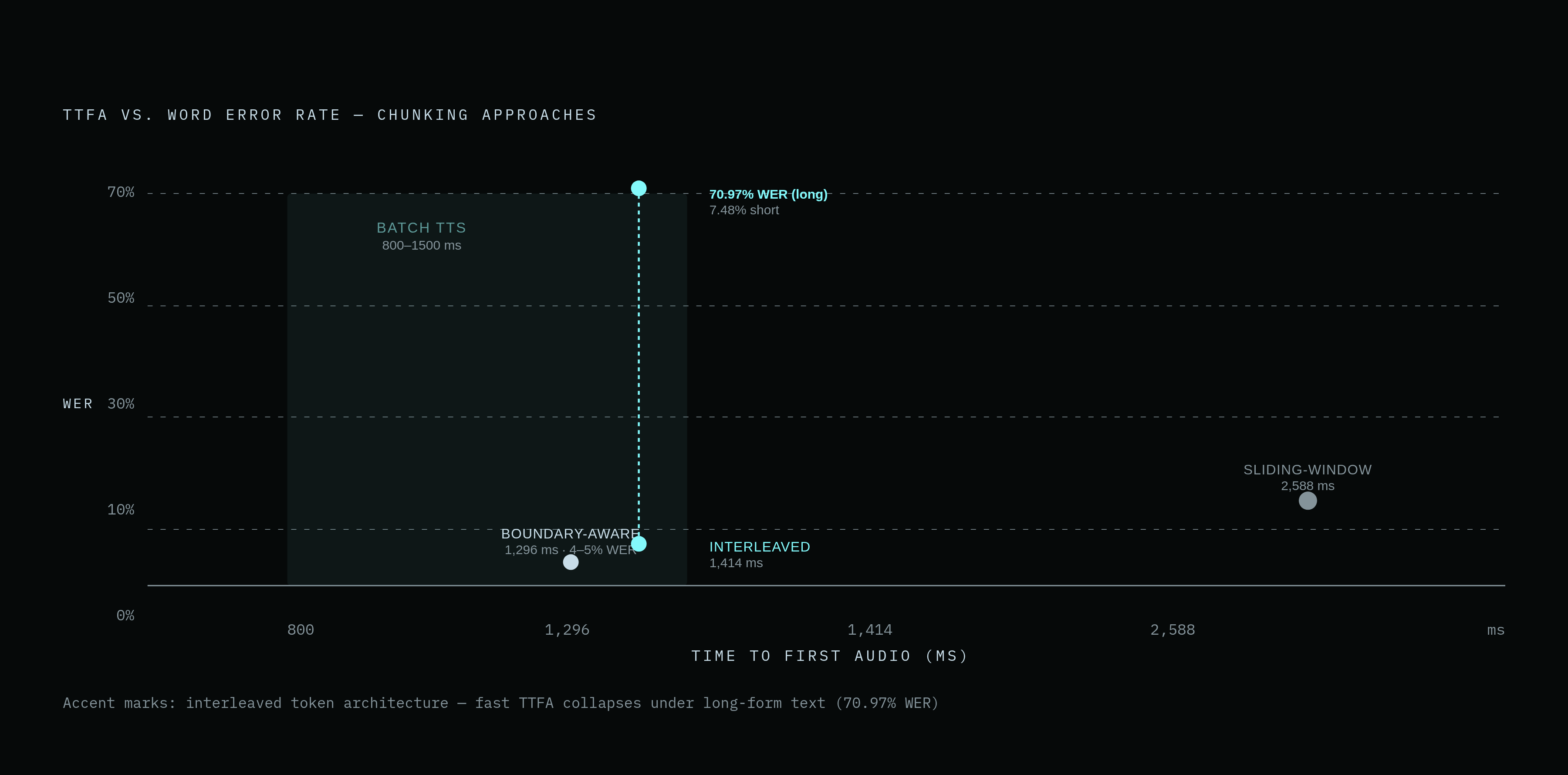
The tradeoff inside lookahead does not bend. A bigger lookahead window buys better prosody at the cost of higher TTFA; a smaller window buys faster first audio and gives up prosody as the window shrinks. Boundary-aware streaming tries to split the difference by pairing a limited future-word window with punctuation-aware boundaries and a sliding prompt kept inside a fixed lookahead budget. In one controlled comparison using a chunk size of five words and a lookahead of two words, this boundary-aware method hit a TTFA of 1,296 milliseconds, well ahead of a sliding-window approach at 2,588 milliseconds, though still behind interleaved token methods. Every bit of lookahead added to improve quality is time added straight to TTFA. Free lookahead does not exist; somebody always pays for it, and here it gets paid in milliseconds, not dollars.
Interleaved text–speech token architectures and where they push the latency floor
Here is a genuinely different move, not just a tweak on the sentence-versus-chunk question. Instead of finishing a text chunk and then synthesizing it, an autoregressive decoder generates speech tokens interleaved with text tokens, so audio starts coming out while the upstream LLM is still writing its response. Earlier LLM-based TTS systems concatenated complete speech tokens only after the full text arrived, which produced large first-packet delays; interleaving fixes that at the architectural level instead of the buffering level.
A handful of 2025 systems show what this looks like in practice. dots.tts drops first-packet latency from 85.4 milliseconds to 54.4 milliseconds by consuming the LLM's token stream as it decodes rather than waiting for it to finish. SpeakStream, described in a May 2025 arxiv.org paper, measured 45 milliseconds of latency on an M4 Pro Mac Mini using word-level forced alignment to pair speech chunks with a text window. SyncSpeech applies forced alignment at the level of individual BPE tokens, at the cost of a more complex model to train and run. ELLA-V aligns phonemes to speech using both global and local advance strategies and beats the non-aligned VALL-E baseline it gets compared against.
None of this comes free, and the quality caveat deserves more than a footnote; it is arguably the whole story. In the same controlled benchmark, interleaved approaches hit a respectable 7.48% word error rate on standard text, then climb to 70.97% on long-form text. That is not a minor dip. That is the system falling apart mid-sentence. Boundary-aware methods, by comparison, held steady at 4.03% and 4.77% across both conditions. And on raw compute, interleaved architectures actually ran slightly less efficiently, with a real-time factor of 0.843 against boundary-aware's 0.782, despite posting a higher TTFA of 1,414 milliseconds against boundary-aware's 1,296. Read that plainly: interleaved architectures earn their keep in short conversational exchanges where every millisecond of TTFA counts, and they are a poor fit for long-form narration or document reading, where quality needs to hold for minutes, not just survive the first sentence. Reaching for interleaving because it benchmarks fastest, without checking utterance length first, is optimizing for the demo instead of the deployment, and that is the mistake worth naming plainly: it is the single most common misread of this whole technology.
Vocoder and acoustic backend constraints that chunking decisions cannot override
None of the chunking strategy above matters if the acoustic backend underneath cannot stream in the first place. CNN-based vocoders like HiFi-GAN work on continuous features and need overlapping frames because of how their receptive fields are built, which means they cannot emit a waveform until enough frames have piled up. That is a latency floor set by the acoustic stage itself, and no amount of clever chunking upstream gets around it. Practitioners who spend a week tuning sentence-boundary logic against a HiFi-GAN backend are polishing the wrong end of the pipe; the floor was never going to move, no matter how clever the chunking got.
Most modern streaming systems sidestep the problem by using neural codecs that work on discrete tokens instead of continuous features, letting them emit waveform frame by frame instead of waiting for a batch to fill. Two recent examples push this into sub-100 millisecond territory. VoXtream, from Torgashov and colleagues in September 2025, uses incremental phoneme transformers with a dynamic lookahead window and monotonic alignment through duration tokens, getting first-packet latency down to as low as 102 milliseconds. FocalCodec-Stream, from Libera and colleagues, also September 2025, uses chunked attention paired with causal convolutions to hit a theoretical 80 milliseconds at a bitrate of 0.55 to 0.80 kbps.
Here is the takeaway for anyone shopping vendors: a streaming-capable acoustic backend is table stakes, not a differentiator. When comparing something like Deepgram Aura-2's roughly 313 millisecond end-to-end TTFA against Cartesia Sonic-3.5's roughly 82 milliseconds, part of that gap comes down to model quality. A meaningful chunk of it is also architecture: whether the backend was ever built to stream at all, or whether it was adapted after the fact and still shows the seams.
Matching chunking strategy to use case: a decision framework for practitioners
So which strategy actually fits a given project? Three variables settle it, not intuition, and not whatever the vendor's sales deck recommends. How long are the utterances: short conversational turns, or long-form narration? What is the TTFA target: sub-150 milliseconds for something conversational, or a looser 300 to 500 milliseconds for something non-interactive? And what is the quality floor: can the deployment tolerate word-error-rate degradation on longer sequences, or does that break the product?
Real-time voice agents handling short turns with strict TTFA targets should reach for server-managed streaming with interleaved architectures where those exist, or fall back to sentence-boundary chunking with immediate dispatch on a standard API. Multi-sentence conversational responses, where the TTFA tolerance loosens a bit, do well with pipelined sentence-boundary chunking, adding boundary-aware lookahead if the model supports it. Long-form narration or document reading should stick with batch synthesis or plain sentence-by-sentence dispatch without interleaving, since interleaving is exactly the technique that falls apart over long sequences.
Specialized alphanumeric content, phone numbers, addresses, confirmation codes, belongs with batch TTS as the default, and that is not a debatable point. Whatever latency gets saved by streaming that kind of content is not worth the accuracy lost when a digit comes out garbled. Nobody thanks a voice bot for reading a tracking number 400 milliseconds faster if it reads three of the digits wrong.
Before any of that gets built, figure out whether the target API is client-managed or server-managed. Building sentence-boundary logic on top of a server-managed endpoint wastes engineering time and can make latency worse instead of better. Treat vendor TTFA numbers, the 82, 75, 155, 313 milliseconds cited earlier, as synthesis-only figures measured under controlled conditions, not as a promise about what a live pipeline will do. Real pipeline TTFA also includes however long the LLM takes to produce enough tokens for the first chunk to be ready. Benchmark the whole pipeline, not just the model sitting in the middle of it.
Chunking strategy is a deliberate choice with consequences that show up in milliseconds and error rates, both measurable, both squarely within a practitioner's control. It deserves the same rigor as any other production system: revisited on purpose, not copied once from a sample repo on GitHub and left to rot.