Streaming TTS Punctuation Handling for Natural Pause Generation
Streaming TTS systems use punctuation as real-time pacing commands to balance speed and naturalness.
- Written by
- The Voice Layer Editors
- Updated
- November 6, 2026
- Reading time
- 12 min read
- Sources cited
- 8 sources ↓
What this covers
Streaming text-to-speech systems face a tension that no amount of engineering elegance fully resolves: the tradeoff between how fast a voice starts speaking and how correctly it speaks once it does. Getting punctuation handling right means making deliberate calls about where to cut the audio stream, how long each pause should run, and how far ahead the system is allowed to peek before it commits to a sound.
The core difficulty is commitment. A streaming engine has to start synthesizing the first tokens of a sentence before it has any idea how that sentence ends, and without some kind of lookahead, the intonation it picks is often wrong by the time the sentence resolves. Prosody isn't a local property of a word; it's a property of the whole utterance. A question trails upward at the end in a way a statement doesn't, and the emphasis pattern across a list depends on knowing the full list, not just the first item. None of that is available to a system reading token by token off a live stream.
Punctuation is the one signal a streaming engine can actually lean on. Stripping out the commas, periods, and question marks causes the system to lose its only reliable cue for where a pause belongs, where pitch should reset, or where a breath would naturally fall. Neither failure is subtle. Listeners catch both within a fraction of a second.
Interactive voice systems raise the stakes further. That constraint is structural: start sooner and time-to-first-audio drops, but prosodic accuracy suffers; wait for a clean boundary; a full clause or sentence, and the prosody improves while the listener sits throu... It's structural: start sooner and time-to-first-audio drops, but prosodic accuracy suffers; wait for a clean boundary; a full clause or sentence, and the prosody improves while the listener sits through more dead air. Every design decision covered in the sections that follow, chunk boundaries, pause durations, lookahead windows, is a position taken somewhere along that same curve.
What punctuation signals to a TTS engine under streaming
Batch text-to-speech has an easy job by comparison. The engine has the entire string in hand before it produces a single sample of audio, so punctuation functions as a post-processing hint layered onto text whose full structure is already known. A comma three words from the end of a paragraph is unambiguous, because the system can see the paragraph.
Streaming removes that luxury. Text arrives token by token, and the engine has to act on each punctuation mark the moment it appears, with no visibility into what comes after. That reframes punctuation from grammatical decoration into something closer to a direct command: per Deepgram's Aura documentation, every comma, period, and ellipsis functions as a pacing instruction issued straight to the synthesis engine. The mark exists to tell the voice what to do next, in real time, with no chance to revise. It's an operator telling the voice what to do next, in real time, with no chance to revise.
Different marks carry different instructions. A period signals a full stop and a pitch reset; a comma calls for a brief breath and a slight pitch hold that signals continuation rather than closure; an ellipsis asks for something closer to hesitation, an extended pause with trailing intonation that mimics a speaker still thinking. Quotation marks and capitalization work differently still: according to Deepgram's documentation, they shift emphasis and intonation rather than triggering a pause at all. Treating every mark as an equivalent pause trigger flattens distinctions that listeners register instantly, even if they couldn't name what's off.
The batch assumption that a mark's role is knowable in advance simply doesn't hold in streaming. A comma might separate items in a list, mark a clause boundary, or sit inside a decimal number as a separator with no pause value at all, and a streaming engine has to decide which case it's looking at using only the text that came before it. There's also a quieter failure mode: rendering pauses as pure digital silence strips out the breath intakes and small mouth sounds that human listeners use, often without realizing it, to predict when speech is about to resume. Batch systems rarely bother with this. Streaming systems, which are judged against a bar of conversational naturalness rather than mere intelligibility, don't have that luxury.
The pause duration hierarchy that practitioners and platforms converge on
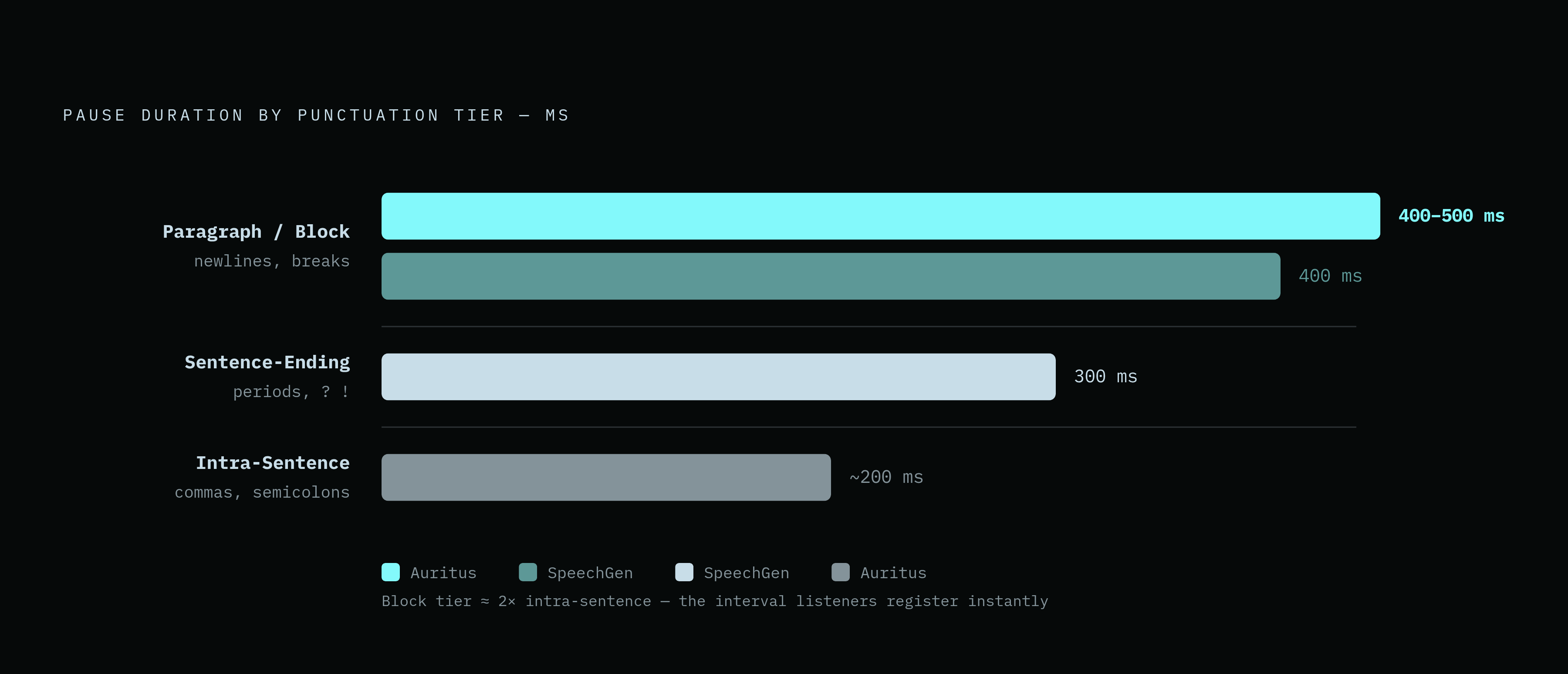
A strikingly consistent hierarchy appears across independent platforms and practitioner writeups. Nobody's proposing it as a universal physical constant, but the relative ordering, short here, longer there, holds up across systems built by different teams for different reasons.
Intra-sentence punctuation sits at the short end. According to independent practitioner observation from the Articulate e-learning community, commas produce the shortest pause, periods run a bit longer than commas, and line breaks are almost double the length of a comma pause. Three different sources, converging on the same shape.
Sentence-ending punctuation occupies the middle tier.
Paragraph and block breaks sit at the top. Long-form audio, an audiobook chapter, a multi-section report, would reasonably call for pauses longer still at chapter boundaries than at paragraph boundaries, which in turn run longer than sentence boundaries. Nobody's shipped hard numbers for that tier yet, but the underlying logic doesn't stop at the paragraph.
None of these figures are ceilings. SSML and other explicit pause controls allow durations from near-zero up to several seconds; the numbers above represent tuned defaults for what sounds natural at a conversational pace, not the outer limits of what's possible. That distinction matters for streaming specifically, because the engine has to assign the right tier to each mark the instant it arrives. Getting the tier wrong by a single level, treating a comma like a paragraph break, or a sentence-ending period like a mid-clause comma, is immediately perceptible to a listener, even one who couldn't articulate the millisecond difference if asked. Auritus's open-source TTS embed, released under the MIT license via PR #57 and merged September 19, 2026, inserts a ~200ms natural hesitation gap at intra-sentence punctuation. SpeechGen's global default for sentences applies 300ms after every sentence-ending punctuation, as specified by SpeechGen in April 2026. SpeechGen's global default for paragraphs applies 400ms between text blocks separated by a blank line, as specified by SpeechGen in April 2026. PR #57 sets Auritus's block breaks at 400ms–500ms.
SSML as the explicit control layer
The strength attribute maps cleanly onto the punctuation tiers already described. That mapping is useful precisely because it lets a developer override the engine's automatic guess whenever the automatic guess is wrong, which, given the ambiguity built into live punctuation, happens often enough to matter.
Google's Gemini TTS treats the <break> tag as a way to insert silence for fine control over rhythm and pacing, on top of the pauses that plain punctuation already produces on its own.
Not every engine plays along, though. ElevenLabs' Eleven v3 doesn't support SSML break tags at all, so developers control pacing instead through audio tags like [pause], [short pause], and [long pause], along with punctuation choices such as ellipses and deliberate text structuring. That reflects a deliberate design choice rather than an oversight. It reflects a broader shift in how neural TTS engines are being built: increasingly, prosody gets inferred from text structure and natural-language framing rather than from explicit markup, which can make SSML feel redundant in day-to-day use. The cost of that shift is real, though. It trades away the deterministic guarantee that SSML provides. SSML remains the reliable floor for anyone building on that requirement, and its absence in some neural engines is a considered design tradeoff, not a gap waiting to be patched. Where no <break> tag is present at all, the engine falls back to inferring the pause from linguistic context, and in a streaming pipeline, that context is by definition incomplete. SSML serves as the baseline contract, offering deterministic, portable pause control supported by AWS Polly, Google TTS, Azure Speech, IBM Watson, Twilio, and others. The <break> tag is the primary pause mechanism, accepting a strength attribute and a duration attribute ranging from 0 to 10 seconds.
Chunking strategies: where to cut the stream so synthesis sounds intentional
Feeding a TTS engine one token at a time is a mistake almost everyone building these pipelines learns quickly. Word-by-word synthesis produces choppy, unnatural rhythm, because the model needs clause- or sentence-level chunks to place pitch and emphasis correctly, a point Soniox's Voice AI Wiki lays out clearly as of July 2026. The practical fix that's emerged across implementations is to buffer incoming tokens and flush the buffer only when a punctuation boundary shows up.
One concrete version of this appears in GitHub issue #52 on the FRIDAY project, dated September 2026: split the buffer on sentence-ending punctuation followed by whitespace, on clause-level punctuation like commas, semicolons, and colons followed by whitespace, or once the buffer simply exceeds a character threshold. That's a workable scoping rule for a large share of everyday English prose, though that framing is editorial rather than a claim made in the issue itself. Punctuation marks are the natural flush triggers in this scheme. Misclassifying one carries real cost downstream.
There's some breathing room built into the timing here. Research documented in arXiv:2603.23346 finds that a five-word prefix yields roughly two seconds of speech, comfortably more than the generation time most LLM backends need to produce the next chunk, so synthesis can start early on a short prefix without the audio buffer ever running dry. That margin is what makes early flushing viable at all.
Fixed thresholds create their own problems, though. The problem compounds outside English. The fix isn't a better constant; it's recognizing that no single constant belongs in the code at all. The threshold needs to be a per-deployment configuration set according to the language and application in play. Where possible, chunk boundaries should track actual prosodic boundaries rather than arbitrary character counts, since releasing a chunk mid-clause forces the engine to synthesize a pitch contour it can't yet resolve. A hard-coded minimum chunk length of 20 characters in some implementations means short openers of 5–7 characters always buffer and ride with the following sentence, adding a full LLM sentence of delay at the most latency-sensitive moment of a voice interaction, as noted in PR #96933 on September 8, 2026. For CJK text, 20 characters amounts to one to two full clauses, so the threshold that protects English prosody actively harms CJK TTFA.
Punctuation tier systems: ranking marks by their segmentation value
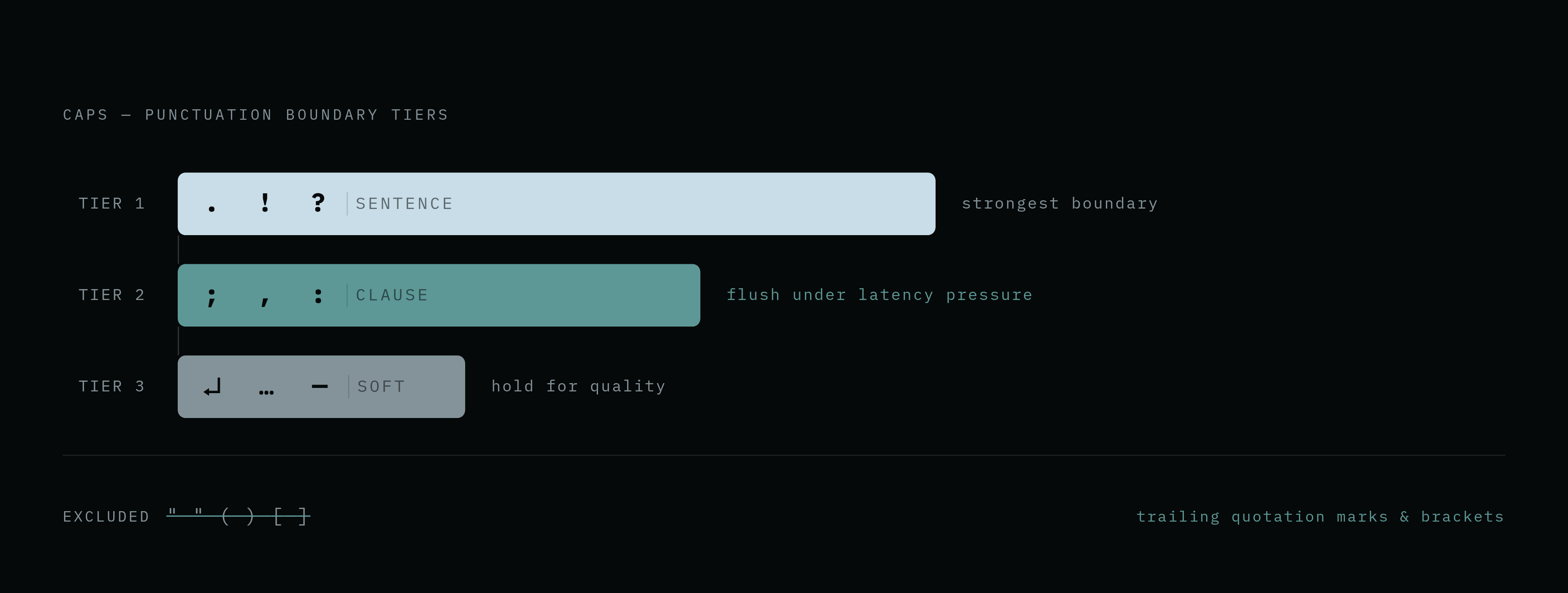
Not every punctuation mark deserves equal weight as a chunking trigger. Flush on every single comma and the output turns choppy and overly segmented; ignore commas entirely and chunks grow too long, letting prosodic drift creep in over the length of the utterance. The fix that's emerged in the research literature is a formal tier system.
The X2Streaming-TTS framework, described in arXiv:2608.18661 from 2026, calls its version Capacity-Adaptive Punctuation-aware Segmentation, or CAPS. It sorts punctuation into three tiers. The strongest boundary signal, tier one, covers sentence-final marks: periods, exclamation points, question marks. Tier two covers clause boundaries: commas, semicolons, colons. Tier three covers softer boundaries: line breaks, ellipses, dashes. Trailing quotation marks and brackets are deliberately left out of the tier system altogether, since they don't reliably signal a prosodic boundary on their own.
The Auritus pull request implements a comparable hierarchy in practice rather than in theory. Em-dashes in their various forms, ellipses, and explicit pause markers each get distinct handling, and block breaks are treated as categorically separate from intra-sentence pauses. Two independent efforts, one academic, one shipped in an open-source codebase, arriving at the same basic structure.
What the tier label actually buys a system is adaptability. Under latency pressure, the chunker can flush at tier two and accept slightly rougher prosody in exchange for speed; under quality pressure, it can hold out for tier one and accept the added delay. The tier is a policy lever. It's a policy lever.
Numbers deserve special handling within this scheme, because a partial numeric expression is one of the easiest ways to get tier assignment wrong. X2Streaming-TTS reports 0% character error rate and 100% correct readings on numeric and streaming-ambiguous items by simply holding an incomplete expression back until one more token arrives to resolve how it should be pronounced. Patience, in this narrow case, is the entire fix.
Lookahead mechanisms: how much future text a streaming engine can afford to see
Correct prosody on the current word frequently depends on knowing where the sentence is headed, and that's precisely the information a streaming system releases text before having. Three broad strategies have emerged in the research literature for managing that gap.
The first adapts a pretrained LLM-based TTS model to recognize prosodic boundaries using only a small window of future words, maintaining a sliding-window prompt of prior text and speech tokens so the model's context stays bounded rather than growing without limit, an approach from Sheng et al. in arXiv:2603.06444, 2026. The second, associated with the MagpieTTS-LF approach from Ghosh et al., pairs punctuation-aware chunk boundaries with an attention-tracking state that folds in historical text alongside a soft prior at inference time. The third, Nvidia's S5-TTS, accepted at Interspeech 2026 and described in arXiv:2606.21882, runs both its encoder and decoder word by word, with the encoder processing, for each word, that word, everything before it, and a fixed number of lookahead words denoted k, while the decoder autoregressively generates the audio for the current word. What separates this from unbounded lookahead is that k is fixed and configurable rather than open-ended.
Sliding-window designs solve a specific failure mode that occurs in long-form generation: unbounded context tends to degrade coherence over time, whereas a bounded window keeps chunks stitching together cleanly without the system dragging along an ever-growing memory of everything said before.
The k parameter in S5-TTS is where the latency-quality tradeoff becomes an actual dial rather than an abstract tension. Push k higher and prosody improves, because the encoder sees further ahead; pull k lower and time-to-first-audio drops, because there's less to wait on. The punctuation tier assigned to a given mark is what tells the system which direction to lean. Lookahead isn't free in either direction, though: it adds a delay proportional to how long those k future words take to arrive, a cost that's easy to justify at a tier-one sentence boundary where getting the contour right matters, and much harder to justify at a tier-three soft boundary where immediacy counts for more than a perfectly shaped pitch curve. There are three broad approaches in the research literature.
Edge cases where punctuation handling breaks down in practice
Locale is where a lot of these systems quietly fail. In German, French, Italian, Spanish, and several other languages, the comma serves as the decimal separator rather than a clause boundary. A documented case from GitHub issue #76 on the hass-edge-tts project, filed September 11, 2026, shows the string "22,1 Grad" gets split at the comma, the comma itself becomes a pause instruction, and the "1" starts an entirely new chunk, so the system reads out "zweiundzwanzig [pause] eins" instead of the correct decimal reading. The same text run through direct, non-streaming synthesis produced the correct pronunciation, which confirms the failure sits specifically in the streaming chunking logic rather than in the underlying voice model. The fix is narrow but effective: exclude any comma sitting directly between two digits from the separator pattern, so a decimal number stays inside one chunk. The larger lesson generalizes past this one bug.
Abbreviations cause a related but distinct failure. Titles like "Mr." or street designations like "Ave." carry a period that looks, to a naive classifier, exactly like a sentence-ending mark, and treating it as tier one produces an unwanted full stop and pause in the middle of what should be a continuous phrase. Fixing this requires tokenizer-level disambiguation ahead of tier assignment; the punctuation mark alone doesn't carry enough information to resolve the ambiguity.
Numeric and symbol-heavy text presents the same underlying challenge from another angle. Numbers, units, currency figures, and mixed alphanumeric strings need to be held as a pending tail rather than chunked immediately, because a partial numeric expression released too early has no reliable way to signal how it should ultimately be read. Across all three edge cases, decimal collisions, abbreviations, and numeric strings, the pattern repeats. Punctuation alone is not self-interpreting. A mark's function depends on what surrounds it, and a streaming system that commits to a tier before that context is available is, by construction, guessing.
Methodology & sources
- feat(tts): add nuanced pause generation for em-dashes and punctuation hints by endymion · Pull Request #57 · AnthusAI/Auritus
Provided concrete pause duration values from a shipped open-source implementation, including the ~200ms intra-sentence hesitation gap and 400ms–500ms block breaks.
- Add Precise Pauses to Your TTS
Provided SpeechGen's default pause durations: 300ms after sentence-ending punctuation and 400ms between paragraphs separated by blank lines.
- Some options for controlling pauses in Text-To-Speech (TTS) | E-Learning Heroes
Provided practitioner observations on the relative ordering of pause durations across punctuation types, confirming commas produce the shortest pauses and line breaks are roughly double the length of comma pauses.
- https://github.com/NousResearch/hermes-agent/pull/96933
Documented the problem of hard-coded minimum chunk lengths causing short openers to buffer and ride with the following sentence, adding latency at the most sensitive moment.
- https://help.elevenlabs.io/hc/en-us/articles/13416374683665-How-can-I-add-pauses
Provided details on ElevenLabs' Eleven v3 approach to pause control, including the audio tag alternatives to SSML break tags.
- Streaming TTS splits at commas: decimal commas lose the spoken word ("22,1" is spoken as "22 1") · Issue #76 · hasscc/hass-edge-tts
Provided the documented case of decimal comma splitting in streaming TTS, where '22,1 Grad' was misread as 'zweiundzwanzig [pause] eins' instead of the correct decimal pronunciation.
- https://soniox.com/wiki/streaming-tts
Provided the principle that TTS models need clause- or sentence-level chunks to place pitch and emphasis correctly, cited in the chunking strategies section.
- https://arxiv.org/pdf/2608.18661
Provided details of the X2Streaming-TTS CAPS framework, including the three-tier punctuation hierarchy and the 0% character error rate on numeric expressions.