Streaming text-to-speech: chunking, prosody, and the time-to-first-audio problem
Streaming TTS requires optimizing latency over voice quality to feel natural.
There's a problem nobody warns you about when you first integrate text-to-speech into a product, and it's not the one you think you're solving. Developers almost universally start by evaluating voice quality: pull some sample audio, run informal listening tests with colleagues, debate naturalness. Reasonable instinct. Wrong problem. The thing that actually breaks the experience is latency. Specifically, the brutal gap between when a user expects to hear something and when audio actually begins. Fix that gap and TTS feels like a conversation. Ignore it, and even the most beautiful synthetic voice feels broken, no matter how much you spent on the model.
What "Streaming" Actually Means Here
Text-to-speech has historically operated on a simple request-response pattern: send a complete string of text, wait for the model to synthesize the full utterance, receive an audio file. For a lot of use cases, that's fine. But pair that model with a large language model generating output token by token, and you have a structural mismatch on your hands.
The LLM is producing text continuously. The TTS engine is sitting idle, waiting for a complete payload that will never arrive as a single clean block. The result is a compounding delay that users experience as the system "thinking" far longer than it actually needs to.
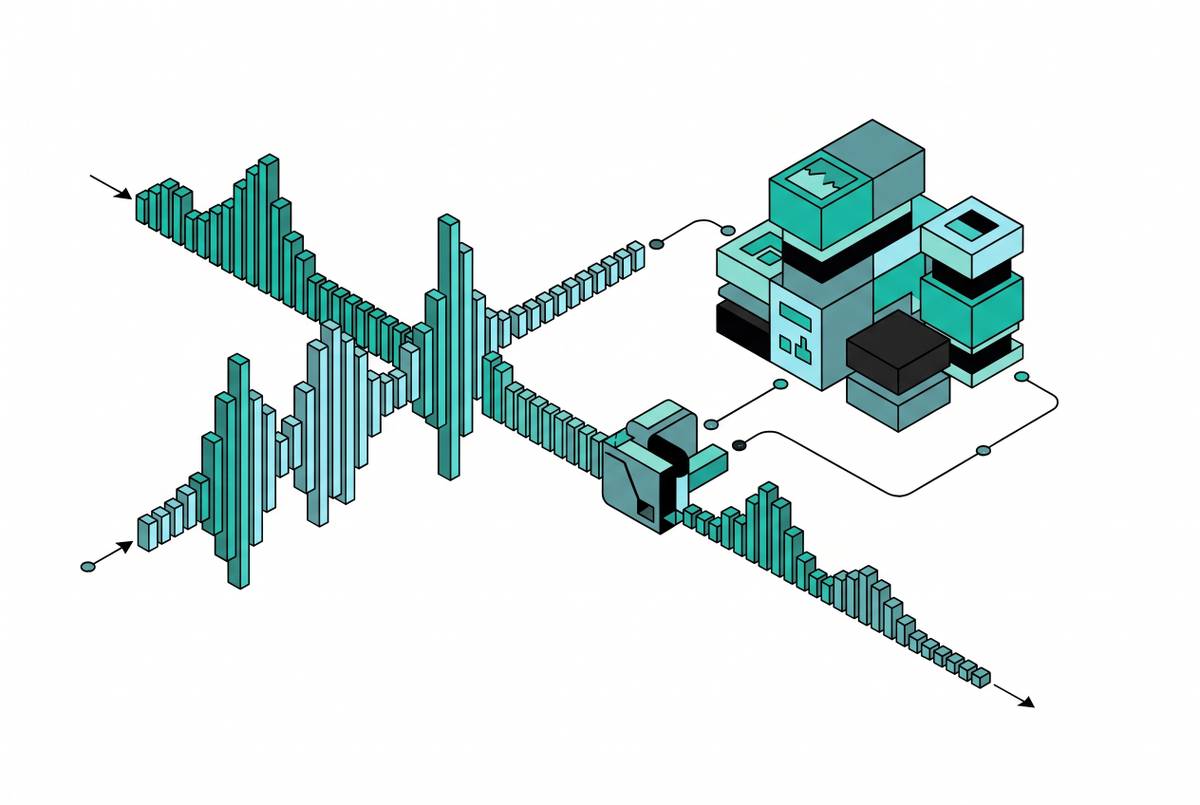
Streaming TTS resolves this by allowing the synthesis engine to begin generating audio before the full input text is known. Text feeds into the engine incrementally, audio starts playing as soon as the first chunk is synthesized. That's the fundamental shift. Everything else, chunking strategy, prosody handling, buffer management, flows downstream from that one architectural decision.
The Chunking Problem
Once you commit to streaming synthesis, the first real problem is deciding how to segment the incoming text. Chunking. And it matters considerably more than most teams anticipate going in, which I say not as a caveat but as a hard-won observation from watching teams learn it the expensive way.
Chunk too small, at the word or two-word level, and the synthesis engine doesn't have enough context to make confident prosodic decisions. The voice sounds choppy, uncertain, like someone reading a ransom note one word at a time. Chunk too large and you've partially recreated the original latency problem; now you're waiting for a full sentence or several before any audio goes out.
The practical sweet spot for most production systems lands around the sentence or clause boundary. A complete independent clause gives the model enough syntactic context to render natural rhythm and inflection without requiring you to wait for an entire paragraph to accumulate. Punctuation becomes your friend: periods, commas, semicolons, question marks, all of them serve as reliable segmentation signals when you treat them as infrastructure rather than formatting noise.
The complication is that LLM output doesn't always produce clean punctuation in predictable cadences. A model generating a long, complex sentence might produce forty tokens before hitting a comma. You can't always wait. So most production implementations layer a secondary time-based or token-count trigger alongside punctuation detection: if a threshold is crossed without a natural break, the system forces a split at the nearest syntactically safe point. This is where engineering judgment starts to matter as much as model quality, maybe more.
Prosody: The Part That's Genuinely Hard
Prosody is the musical layer of speech. Pitch, rhythm, stress, timing. It's what makes a question sound like a question before the listener has consciously processed the words. It carries sarcasm, emphasis, urgency. You don't notice it when it's right. You notice it immediately when it's wrong.
In non-streaming synthesis, the model sees the full sentence before generating audio. It can plan. It knows the sentence ends with rising inflection, that a particular word carries semantic stress, that a list is coming and the rhythm should shift accordingly. Global context informs every local decision.
In streaming synthesis, you're making prosodic commitments with incomplete information. The system starts synthesizing "The results were" and renders those words with a neutral, expectant tone. Then the next chunk arrives: "catastrophic." The stress pattern that would have been obvious in hindsight was invisible at the moment of synthesis. You've already spoken the setup wrong and there's no going back.
I've heard this clip, or a version of it, in enough post-launch reviews to recognize the moment someone realizes what they're actually dealing with. The question is always some version of: why does it sound so detached here? And the answer is always the same. Because the model was reading one measure ahead of a score being written in real time.
Modern neural TTS systems handle this considerably better than older concatenative or parametric approaches, primarily because they've learned statistical associations between partial contexts and likely continuations. But it remains genuinely unsolved in the rigorous sense. The output is probabilistically reasonable, not acoustically optimal. For most conversational applications, that's acceptable. For long-form narration or anything requiring emotional nuance, it's a real constraint.
Some teams address this through a small lookahead buffer: accumulate one additional chunk before synthesizing the current one. A modest latency increase in exchange for meaningfully better prosodic coherence. For voice assistants and real-time dialogue, that tradeoff usually isn't worth it. For audiobook generation or extended reading, it often is. The answer depends on the use case, which means you have to be honest about what your use case actually is, not what you originally imagined it would be.
Time-to-First-Audio: The Metric That Actually Defines the Experience
Time-to-first-audio, TTFA, is the elapsed duration between a system deciding to speak and the user actually hearing sound. It is the single most consequential metric in conversational TTS. It is also, consistently, undertested in early development, because early development tends to happen in low-latency local environments with developers who already know what the system is about to say.
Human perception of conversational responsiveness is unforgiving in a way that surprises people who haven't tested with real users under real conditions. Pauses that feel unremarkable in a podcast feel interminable in a dialogue. The perceptual threshold where a delay shifts from "normal processing" to "something is broken" is shorter than most engineers assume when building in isolation.
TTFA in a streaming system has several compounding components: time for the LLM to generate enough tokens to fill the first chunk, synthesis latency for that chunk, network round-trip time if the TTS engine is a remote API, and audio buffer overhead on the client side, the minimum audio the player needs before it will begin playback without risking a stutter. Each component is independently improvable. None of them is independently sufficient.
Optimizing TTFA is therefore not a single intervention. It requires coordinated work across the chunking strategy, the synthesis infrastructure, and the client-side buffering logic. Teams that treat it as purely a model or API problem plateau well above the threshold that feels natural to users.
What Actually Works
Make your first chunk smaller than subsequent ones. The goal of that initial chunk is solely to start audio as quickly as possible, even if it's just a few words. Once playback is active and the user is already hearing something, the perceptual urgency resolves. Subsequent chunks can be larger without the user noticing.
Treat punctuation as infrastructure from day one. Build a punctuation-aware segmentation layer early and deliberately. The decisions you make about where to split text propagate through your entire audio pipeline, and retrofitting this after the fact is genuinely painful in ways that are hard to fully convey without having done it.
Monitor TTFA as a primary metric in production, and not just the average. Watch the tail: the 95th or 99th percentile. Users don't remember the median experience. They remember the time the system made them wait. Tail latency is where trust erodes, quietly, over many sessions.
Accept the prosody limitation and design around it rather than pretending it doesn't exist. If your application requires high emotional fidelity, consider whether full-sentence buffering with a small latency penalty is more appropriate than aggressive word-level streaming. The best streaming configuration is the one calibrated to the actual use case, not the theoretical ideal.
The Architectural Commitment Nobody Mentions
Streaming TTS is not a feature you toggle on. It's an architectural commitment that reshapes how you build, test, and monitor your voice layer, and the teams that treat it otherwise tend to find out why at the worst possible time, usually under production load with real users waiting.
The latency problem is real. The prosody tradeoffs are real. The chunking decisions compound in ways that aren't immediately visible. Your voice interface is the first layer users form opinions about and typically the last one your engineering team gets around to instrumenting properly. Close that gap before you ship, not after.