Text Segmentation Heuristics That Reduce Streaming TTS Artifact Boundaries
Streaming TTS seams come from early commitment, state resets, and capacity limits.
- Written by
- The Voice Layer Editors
- Published
- November 8, 2026
- Reading time
- 8 min read
- Sources cited
- 5 sources ↓
What this covers
- Why streaming TTS produces audible seams even when segmentation looks correct
- How prosodic commitment under uncertainty produces the first class of artifacts
- How state discontinuity at segment edges produces the second class of artifacts
- How capacity-blind segmentation produces the third class of artifacts
For continuous-sounding streaming TTS, strategically dividing the text alone is not enough. Audible boundaries emerge when prosody commits too early, the acoustic state is reset, or segmentation exceeds engine capacity. Text segmentation heuristics curb these artifacts by tackling all three causes together: leaving uncertain text provisional, maintaining stable speech generation, and adapting segments within the available decoding budget while retaining first-audio latency.
Why streaming TTS produces audible seams even when segmentation looks correct
Once speech is emitted, there is no going back. The synthesizer therefore has to settle on pronunciation and prosody using only a partial text lead-in, before later tokens clarify the meaning. X2Streaming-TTS gives the example “He finished 3”: it may be read as “three” if “laps” follows or as “third” if “place” follows. Once spoken, the numeral locks in a single reading. The same danger applies to abbreviations, measurements, and numbers whenever segmentation leaves the pronunciation cues in text that has not arrived yet.
That commitment issue is only the first way things go wrong. Even a grammatically sound splice exposes abrupt shifts in the acoustic state whenever the following segment lacks prior context. Reconstructing the waveform decoder's cache happens as timbre, energy, and pitch stabilize locally. Audiences perceive this fresh start as an audible join, regardless of whether the wording was divided logically. The study documents quantifiable pitch jumps when proper splits lack inherited vocal state.
Because the engine’s acoustic decoding capacity is finite, punctuation marks and character totals alone cannot indicate a passage’s share of that capacity. Once generation uses up that capacity, an involuntary truncation can occur where the linguistic break would be unsuitable. Even with correct pronunciation choices and intact state, this can still happen.
How prosodic commitment under uncertainty produces the first class of artifacts
Uncertainty-aware buffering keeps prompt speech on track by postponing any incomplete numerical value, measurement label, shortened form, or symbolic notation until it can be pronounced unambiguously. The authors term this approach causal commitment. Whereas buffering by sentence holds all tokens until completion, this approach addresses expressions that later tokens may reinterpret. Although it settles such uncertainty across a wider span, sentence-level buffering forfeits the low-latency benefit that streaming aims to deliver.
Punctuation detection has to work within that same distinction. A period can attach to abbreviations, decimal notation, or ordinal forms. Ending a segment at “3.” risks outputting it before later text such as “rd” or “laps” shows what it means. In practice, the system first applies a small token classifier to hold back numbers, units, and familiar abbreviation forms, then lets punctuation rules proceed. Only once the classifier has resolved the ambiguity does boundary-based sentence detection consider a candidate.
In November 2026, PRs #515 and #517 documented a hermes-vox issue where colons alongside commas and semicolons caused breaks following merely 2–3 words. As a result, the engine received chunks lacking acoustic substance. The solution postponed breaks at soft punctuation until enough characters had built up. Here, that limit decides when punctuation may serve as a split point instead of discarding linguistic structure for rigid windowing.
Punctuation-only fragments call for tighter handling than delayed splitting. In the same debugging case, one such chunk produced roughly 1.1 s of dead air, and the lifecycle read this as the engine failing. This caused a re-warm and a mid-reply drop to the system voice. The fix is to stop punctuation-only output completely and fold trailing punctuation into a neighboring content segment.
How state discontinuity at segment edges produces the second class of artifacts
In the ablation that drops speech-state inheritance, pitch jumps measurably where segments meet, showing segmentation alone cannot make up for restarting the decoder. Segmentation and state continuity do different jobs. Segmentation decides where text can split, while state continuity lets synthesis carry on using the audio generated so far. Both are needed to make the handoff sound smooth.
The handoff proceeds along two separate paths. The full Code2Wav state passes on the frame index along with KV, convolution, and transposed-convolution data so waveform decoding can pick up warm in the following segment. The remaining Talker state tail, kept in token sync, supplies the acoustic model with a short context window to use. This scheme eliminates the pitch break that a punctuation-only split would still leave behind.
Inheritance still hinges on the health of the predecessor. Both state paths persist only if the predecessor received full input, processed every admitted token, finished acoustic decoding without error, achieved a valid expansion ratio, and generated an undamaged Code2Wav capture. If any of these conditions are not met, the inherited states are cleared, since a failed or incomplete predecessor offers no trustworthy foundation.
Trimming PCM data reveals another, lower-level discontinuity. The October 2026 Android report for Eloquence TTS, issue #239, links the crackle to chunk boundaries that failed to meet zero crossings and lacked brief fades at either edge. A useful precaution is to cut at or close to zero crossings while retaining a little of the engine’s original onset and final quiet.
Lengthy segmented replies may gradually lose prosodic consistency near the edge of the context window, so simply keeping all prior history will not solve it. Capped sliding prompts are one way to stabilize that drift. Its method applies an attention-prior limit that masks later positions while retaining only a small span of acoustic context.
How capacity-blind segmentation produces the third class of artifacts
A text segment lacks any predetermined acoustic expense. The engine maps textual units to a fluctuating count of audio frames, with ρ capturing how many frames emerge per token. Both the spoken material and the voice identity cause ρ to shift. So a fixed character window gives the scheduler no way to know if the next passage fits inside the remaining decoding budget. What arrives may either exceed or fall short of the allotted capacity.
Their capacity-adaptive method derives ρ using the actual decoding operations and textual units of the most recently completed segment. The derived value next determines if the active buffer can accommodate additional tokens prior to segment closure. This turns engine capacity into an input for segmentation. While punctuation continues to suggest where boundaries might fall, the acoustic projection limits how much longer the scheduler may accept incoming words. The matching heuristic triggers segment closure once the projected spare capacity drops beneath a safety margin.
The minimum character threshold applied to soft punctuation works differently. The character limit stops commas from splitting off acoustically thin fragments, whereas the capacity estimate keeps segments within decodable bounds. One cannot take the place of the other. Relying solely on character counts risks accepting oversized chunks, while depending exclusively on punctuation may delay segmentation past the optimal moment.
Trailing noise and gaps between streamed chunks are production signs that point to segmentation without capacity awareness. A documented case is Google’s 3.8-flash-tts model, reported in September 2026, whose direct API responses contained audible static or scratch-like sounds in their final audio. The web UI covered decoder tail frames with WebAudio post-processing, but direct API consumers got the audio without that masking. A short gate for noise or trailing silence on the consumer side can therefore protect raw responses. This manages the noise at the end rather than correcting how upstream segments audio, while any trimming must remain within waveform boundaries.
Why fixing any one of the three causes in isolation still leaves audible breaks
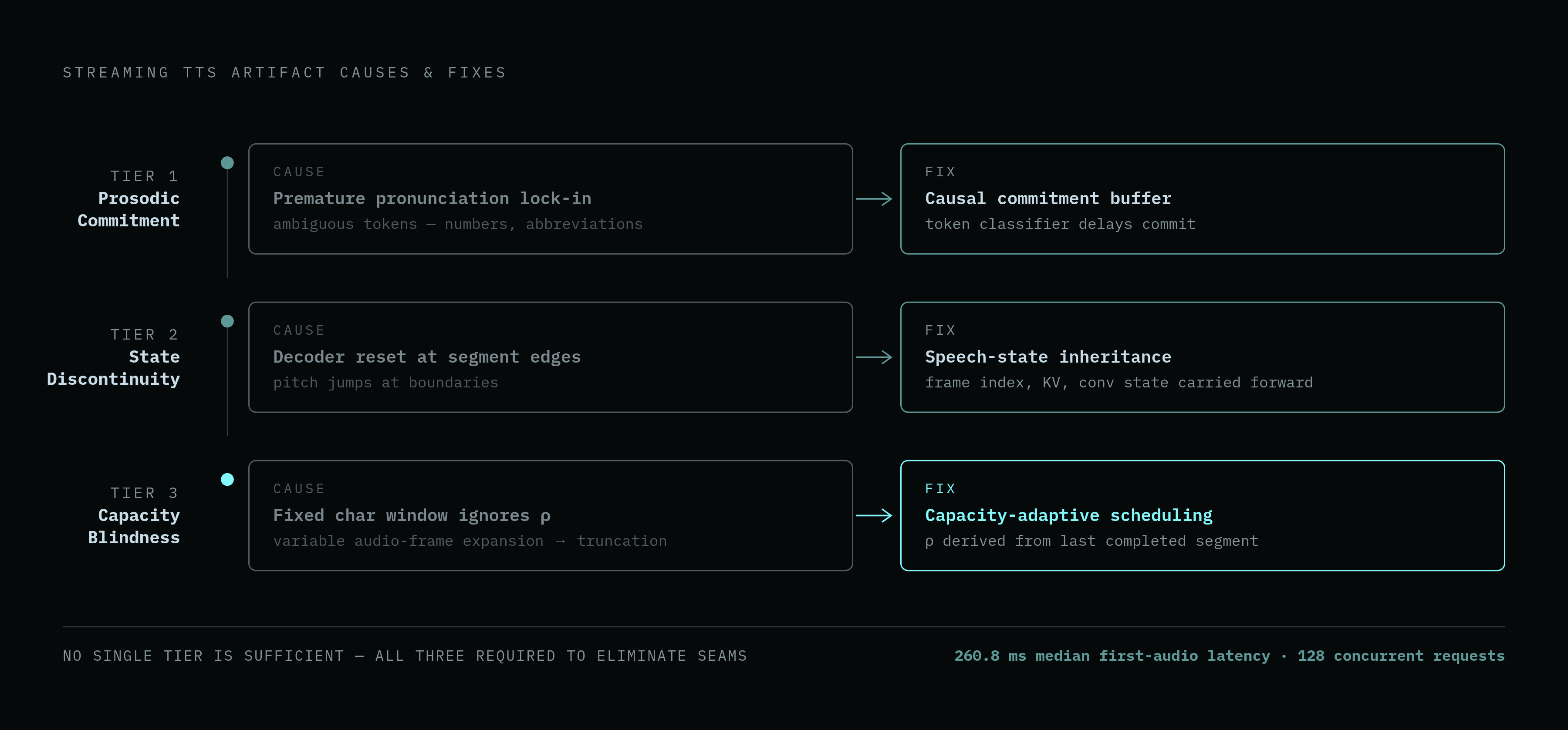
The ablations argue for handling the causes together. Without speech-state inheritance, pitch breaks remain measurable, and without causal commitment, generation capacity can run out and force segmentation that makes no linguistic sense. The paper's causal commitment covers buffering that accounts for uncertainty plus segmentation that adapts to capacity, meaning its removal reveals issues beyond punctuation. Even when a framework treats these as one mechanism, implementations should keep the responsibilities apart.
Buffering only at sentence or clause breaks is not enough to cover the whole job. Prosody receives a full syntactic chunk, yet decoder state is not carried forward, nor is the chunk tested against the acoustic budget. Inheritance fixes the fresh start but leaves overload risk unresolved. Similarly, planning around capacity still leaves a timbral discontinuity whenever state is reset at a boundary.
Lookahead shifts which weakness stands out most. Commitment artifacts grow under very short lookahead, state discontinuity dominates at moderate lookahead, and capacity management dominates once lookahead is sufficient. The cited synthesis finding, where two-word lookahead restores 94% of the representation from full context, shows why lookahead works as a continuous dial. That representation finding does not establish that all boundaries are clean.
A combined heuristic checklist engineers can apply without retraining the model
Start with text preprocessing, then handle how segment states are managed, and finish with capacity-aware scheduling across the three cause classes. Each tier deals with a different source of breaks, so teams can make changes incrementally and evaluate the results one at a time. These heuristics require no retraining. Effort varies by tier, though, since text rules avoid storing decoder state or tracking acoustic expansion.
Only trigger sentence splitting once the token classifier confirms a candidate is unambiguous. Soft punctuation requires the buffer to hold enough characters prior to any split. Prevent segments made entirely of punctuation from standing alone by joining their marks to neighboring text. These preprocessing rules address the premature releases shown in production debugging cases.
Both transfers should only proceed when input is complete, text fully consumed, termination normal, the expansion ratio stays within bounds, and the decoder snapshot remains intact. When validation fails, wipe the system and revert to initial configuration. At the PCM stage, cut close to zero crossings while preserving a little natural lead-in and trailing silence. For lengthy outputs, apply a sliding prompt with fixed bounds to curb context expansion and minimize subsequent prosody drift.
Use the latest ratio to estimate how much additional text fits, then end the current segment once the estimated leftover acoustic capacity drops under a safety margin. This substitutes budget-aware scheduling for the former fixed-size approach. With raw API audio, apply a brief end-of-stream silence trimper or consumer-side noise gate to prevent tail artifacts from the upstream audio. Place that protection after synthesis, next to capacity tracking.
The recommended rollout starts with Tier 1 as the lightest lift, then moves to Tier 2, where added state tracking produces the strongest quality return per engineering hour. Tier 3 demands the most effort and is necessary when deployments involve high concurrency or changing content. The goal is to preserve boundary clarity without delaying the first sound. With all three mechanisms active, the study records a 260.8 ms median before the first audio token under 128 concurrent requests, indicating that coordinated boundary handling can preserve scalable streaming benefits.
Methodology & sources
- X2Streaming-TTS: Causal Token-Level Text-to-Speech from Streaming Text with Speech-State Inheritance
Supplied the causal commitment, speech-state inheritance, and capacity-adaptive segmentation mechanisms and the ablation and latency results.
- Streaming T5-based Text-to-Speech Synthesis with Limited Lookahead
Provided the finding that two-word lookahead recovers most of the full-context representation.
- TontaubeV1: Streaming Text-to-Speechwith Hierarchical Codec Modelingand Bounded Context
Informed the discussion of bounded context and capped sliding prompts to limit prosody drift in long outputs.
- [2603.06444] Prosodic Boundary-Aware Streaming Generation for LLM-Based TTS with Streaming Text Input
Relevant to the argument that boundary placement in streaming LLM-based TTS should follow prosodic structure rather than arbitrary splits.
- ResembleAI/chatterbox-turbo · Artifacts at boundaries during streaming
Documented a real-world case of audible artifacts at chunk boundaries during streaming synthesis.