How Loudspeaker Feedback Reaches the Microphone and What Cancels It
Understanding how acoustic loops form and why placement matters most.
- Written by
- The Voice Layer Editors
- Published
- October 30, 2026
- Reading time
- 8 min read
- Sources cited
- 5 sources ↓
What this covers
- What acoustic feedback actually is: a closed loop between speaker, room, and microphone
- Why the room is not a passive backdrop but an active part of the feedback path
- How microphone and loudspeaker placement set the gain before feedback ceiling
- What "ringing out" a system reveals about the frequency structure of feedback
In a loudspeaker system, feedback circulates through a sealed sound path. Instability starts once the loudspeaker’s output re-enters the microphone with matching phase and enough gain to build on itself. Tracing it shows how placement, equalization, adaptive filters, and neural methods restrain the loop. They all act on that shared circuit, with results shaped by their ability to track acoustic shifts.
What acoustic feedback actually is: a closed loop between speaker, room, and microphone
Air blown over a soda bottle creates a pitch that varies with the internal volume. Pouring in liquid alters the internal volume, moving the resonance. Shure employs this comparison to illustrate the way a sound system and the space around it emphasize specific frequencies. The mic, speaker, and placement in the room each add distinct resonant traits. Feedback arises when the full loop reinforces a single resonant frequency.
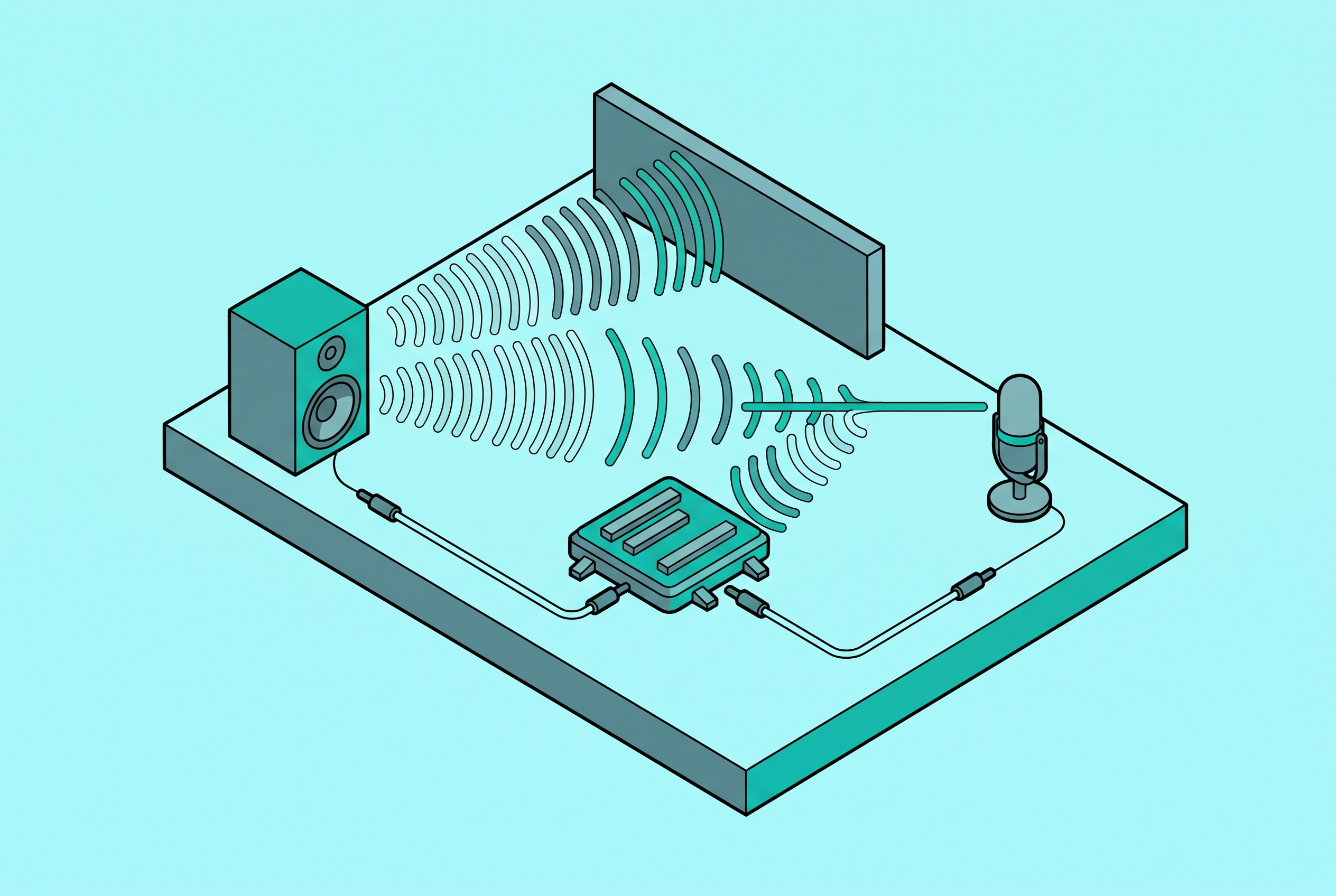
The loop starts when sound leaves the loudspeaker. After moving through the room, some sound reaches the microphone, and the resulting signal is boosted before returning to the speaker. Repetition by itself does not make a howl keep going. The system turns unstable once the sound coming back carries enough phase alignment and level to feed itself. With more gain, the earliest frequency that satisfies the loop’s requirements emerges as the recognizable ring or screech.
So feedback is a trait of the entire linked setup. No microphone can trigger it apart from the amplifier, loudspeaker, plus the acoustic route. The system does not become unstable at every frequency either. The overall loop's spectral behavior dictates the onset of ringing, meaning varied gear or placements yield distinct feedback tones.
Why the room is not a passive backdrop but an active part of the feedback path
The acoustic return path is not just the straight line from loudspeaker to microphone. As sound moves through the room, reflections and timing shifts govern the frequencies that come back strong enough and properly phased to keep oscillating. Resonances in the space may emphasize particular frequencies, while response peaks from the mic and speaker create greater variation in loop gain.
Hard surfaces including glass, wood, and marble reflect audio back toward the microphone along multiple routes, each with its own delays. As a result, real-room reflections can align phase in destabilizing ways across many frequencies. When system gain rises, engineers need to know the frequency that will become unstable first, and the level where it happens.
The room's role shifts as time passes. When people move, doors open, or furniture gets rearranged, the reflection pattern shifts and so do the frequencies most at risk of feedback. The gear can stay the same, yet the sound path shifts around it.
How microphone and loudspeaker placement set the gain before feedback ceiling
GBF, short for gain before feedback, tells how much reinforcement a system can apply to a microphone before it starts to feed back. It is a property of the whole system, room included. The hardware layout sets the usable-gain boundary first, before signal processing has anything to adjust.
What matters is how far the microphone sits from the loudspeaker compared to the desired source. A nearby loudspeaker paired with a distant source causes the mic to capture excess feedback over the intended audio. Such spatial arrangements are common in small tabletop and meeting room systems. Because the user is farther away than the loudspeaker, the maximum output level is severely restricted.
Shure says the strongest hardware adjustment is to shorten the gap between the mic and the sound being captured. This new positioning gives the capsule more desired sound relative to loudspeaker spill coming back. Even as the space and gear conditions shift, placement determines the acoustic margin available for later processing.
What "ringing out" a system reveals about the frequency structure of feedback
Shure outlines a common method for exposing the frequency structure of a sound system’s feedback loop in a real room. Gain rises until feedback begins, then the offending frequency is found by ear or with a meter and reduced with an equalizer. After that, gain increases until another frequency begins to ring. Once the target operating level is achieved, the process stops.
That sequence of tones carries meaning. Instability strikes earliest at tones where the mic, speaker, and room resonances align to produce maximum amplification. Lowering a single peak permits higher gain before a different tone hits the threshold.
The equalizer's precision determines how narrowly each vulnerability can be targeted. Parametric designs allow for more surgical and profound attenuation than graphic units, which keeps the desired audio intact while targeting the problematic frequency. Yet such accuracy fails to ensure lasting outcomes. A setting tuned to a specific venue and group of performers may lose its effectiveness when circumstances shift. Because static equalization cannot adapt, it drives the need for automatic identification and responsive correction.
How notch filters suppress feedback and why they require continuous re-tuning
By attenuating only the exact points where oscillation threatens, notch filtering leaves the rest of the spectrum unchanged. Such precision spares the desired signal from sweeping alterations. Using high-Q designs shrinks the affected band to reduce tonal damage, yet such exactness carries its own risk. Should the feedback frequency drift even a little, the oscillation may escape the zone where attenuation peaks.
The notch method has deep roots. US Patent 4,088,834 describes a setup that removes feedback through notch filters, relying on parallel active filters to nullify acoustic loops via opposing phases. That design differs from simply lowering gain at key frequencies to achieve notch suppression.
These devices apply notch filtering in consoles as well as standalone processors, finding ringing and adding cuts without constant operator oversight. As conditions in the space shift, the filters must be adjusted again.
The core limitation comes down to when the system steps in. Such devices merely react once oscillation begins, so a filter calibrated for a single acoustic environment loses effectiveness as the problem frequency drifts. Running this automatically is what makes such a reactive response practical.
How adaptive feedback cancellation estimates and subtracts the feedback signal before it rings
AFC redirects the processor from chasing feedback after the fact to estimating it. It does this by learning how the loudspeaker’s sound reaches the microphone instead of cutting a tone only after ringback starts. It then removes its predicted echo of the loudspeaker from the microphone feed before that signal is amplified again.
The model is often a filter of the finite impulse response type, abbreviated FIR. The coefficient values encode the path estimate and keep being refreshed while the system runs. To lower the estimation error, engineers often tune the coefficients with the LMS method, short for least mean square.
This distinction gives GBF a theoretical advantage. A notch gives up gain in the frequency range it blocks, whereas precise subtraction can recover most of that gain while still allowing desired sounds in that range. But this benefit is not guaranteed. How well the model mirrors the true return path determines how much cancellation is achieved.
The task grows more difficult whenever the path shifts. As talker position or the surrounding acoustics shift, the target estimate shifts with them, and the ear-canal fit of a hearing aid may shift too.
Where the feedback problem is most severe: the hearing aid case
The receiver, doubling as the speaker, sits just millimeters away from the mic. The unit functions pressed to the ear amid constantly shifting acoustic conditions. Even increased distance provides minimal benefit, as suppression artifacts immediately compromise the wearer's ability to understand speech.
Open-fit designs sharpen the acoustic compromise: leaving the canal partly unsealed to stay comfortable and preserve unamplified bass perception, they also let more sound travel back from the receiver to the mic, so feedback suppression becomes both harder and more essential.
This hearing aid example likewise reveals how restricted the signals are that shape AFC development. Most AFC algorithms were built and validated around speech, so music and broadband audio remain underserved. AFC has to stop a whistle while preserving the audio the user requires.
What deep learning brings to feedback cancellation and why closed-loop training is the critical design choice
Compared with conventional gradient-driven adaptive methods, deep neural networks allow more flexible prediction of the feedback path’s impulse response. At ICASSP 2025, researchers from Aalborg University introduced a neural-network-based method called Deep Feedback Cancellation (DFC) that directly predicts the response. It substitutes this mechanism for the traditional estimation process. By itself, it leaves unanswered how the estimator performs within an active acoustic feedback loop.
This difference is crucial for deployment stability. With closed-loop operation, what the network produces feeds back to become what it receives next. A model prepared without feedback has never encountered this recursive dynamic, so the active system may magnify its mistakes and struggle to control acoustic echo.
At Oldenburg's Carl von Ossietzky Universität, In-the-Loop Deep Feedback Cancellation (DFC-IL) was developed to address this mismatch through closed-loop network training. The work advances both methodology and architecture.
Fengyuan Hao and colleagues presented a hearing-aid system called Low-Latency Low-Complexity Deep Marginal Feedback Cancellation (L3C-DeepMFC) at the Interspeech 2025 conference. The method fine-tunes in a closed loop, drawing on feedback mixtures that are generated dynamically. Both lines of work answer the instability objection the same way: training must match the feedback conditions the system faces in operation.
Why hybrid architectures — neural networks guiding classical filters — are the direction most likely to be deployable
In the near term, hybrid architectures offer the most workable route by pairing complementary methods and assigning each part of the job where it fits best. Stable subtraction in real time remains with the classical filter, while the neural network tunes its adaptation. That network can make path estimation faster and more accurate without taking over the cancellation filter. The result preserves the classical design’s stability strengths while letting deep learning assist with path estimation.
This split matters most for hearing aids. On-device operation is restricted by delay, processing capacity, and power reserves. A fully neural method that demands heavy processing is impractical at that size, yet manufacturers can realistically ship a compact model adjusting a traditional filter. Whether a device can actually ship hinges on factors beyond how well it cancels noise.
Accepted December 2025, a January 2026 study examined real-time execution of conventional and adaptive algorithms on reconfigurable platforms, covering LMS-based interference suppression and frequency-domain techniques. It evaluated the balance of performance, hardware expense, and fitness for rapid-response use.
Hybrids therefore offer their greatest advantage rather than a victory for classical or neural methods alone. Continuous subtraction requires combining a reliable real-time mechanism with an estimator that can track a changing path. Whether the microphone is moved or the network is trained within the loop, the underlying physical goal remains unchanged. Every approach must stop the acoustic return from sustaining itself.
Methodology & sources
- Feedback elimination system employing notch filter
Described the early notch-filter feedback elimination approach using parallel active filters to cancel acoustic loops via opposing phases.
- In-the-Loop Training of Deep Feedback Cancellation for Hearing Aids
Introduced the In-the-Loop Deep Feedback Cancellation (DFC-IL) method developed at Oldenburg's Carl von Ossietzky Universität, which trains the network within an active feedback loop.
- L3C-DeepMFC: Low-Latency Low-Complexity Deep Marginal Feedback
Provided the basis for the discussion of the L3C-DeepMFC hearing-aid system presented at Interspeech 2025, including its closed-loop fine-tuning approach.
- Digital Signal Processing-2 Adaptive notch filters for acoustic feedback control
Supplied the technical background on adaptive notch filters, FIR-based path estimation, and the LMS coefficient update method used in acoustic feedback control.
- An improved acoustic howling control technique with reduced computational load requirement
Provided the January 2026 study on real-time execution of conventional and adaptive feedback algorithms on reconfigurable platforms, evaluating LMS-based suppression and frequency-domain techniques.