Streaming TTS Cost Optimization for High-Volume Applications
Hidden costs beyond listed rates grow exponentially at high volumes.
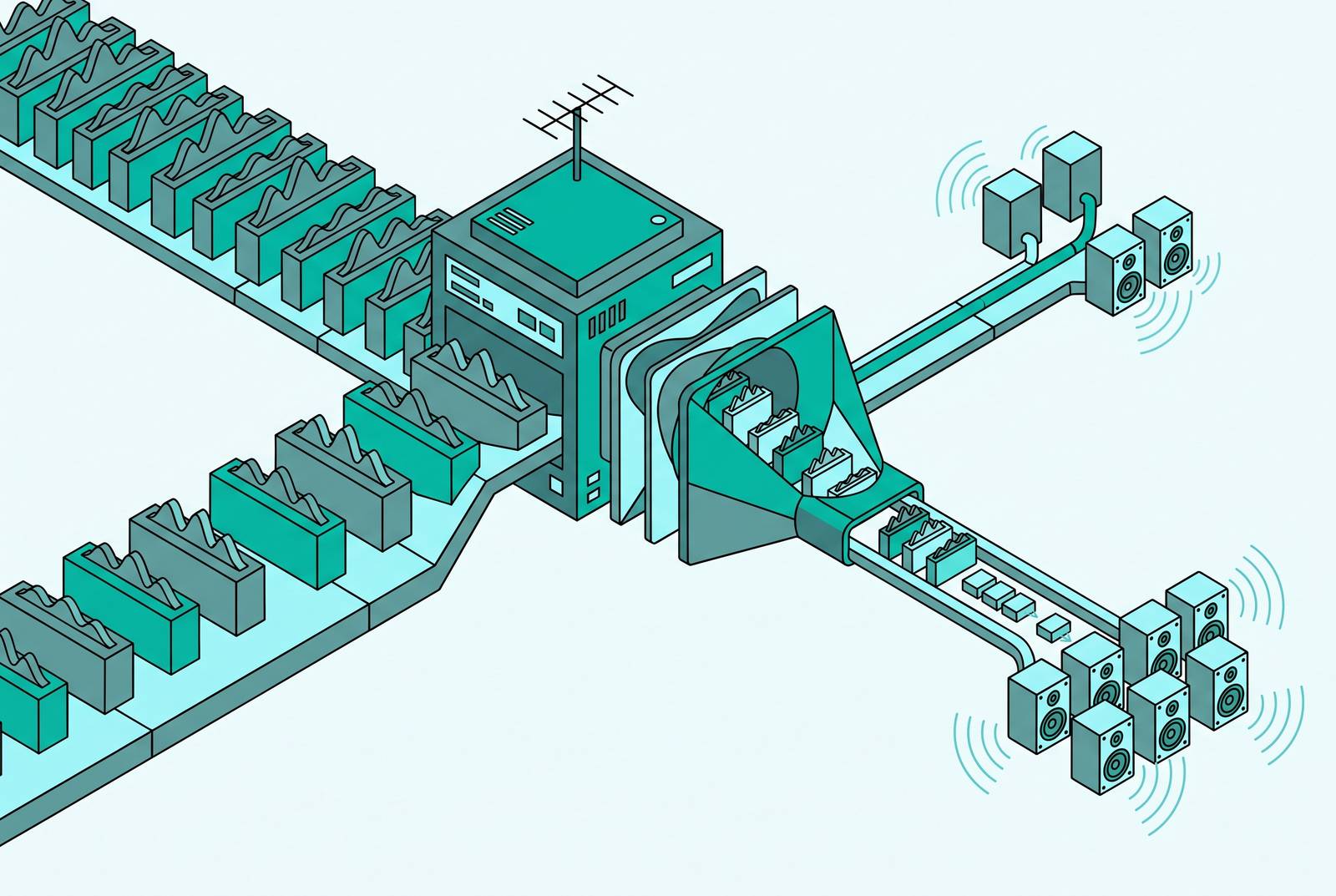
Text-to-speech has quietly turned into plumbing. It’s now the hidden layer for voice agents, IVRs, service bots, and accessibility apps, humming nonstop rather than kicking in occasionally, so the move from add-on to backbone flips the cost math. Customer service and IVR are the biggest users of TTS, so the segment facing the most high-volume pricing pressure is also a huge part of the business. If they're still using a spreadsheet from two years ago to price this, that’s not something to be happy about.
Engineering teams often take shortcuts when calculating costs, simply multiplying characters by the listed rate, getting a quick estimate, and calling it a day. The number they get is usually off, and it's always too low. Hidden costs like concurrency limits, egress fees, SSML overhead, retries, and caching pile up beyond the listed price, and the difference between quote and bill can grow significantly at real scale. These sections track the gap's causes and the quickest fixes, beginning with pricing models.
How the three dominant pricing models create different cost curves as volume grows
Three basic pricing structures cover most of the market, and each bends the cost curve differently as usage climbs. If your traffic shape doesn't match the pricing model, you'll overpay, even with a "cheaper" rate card. The listed price and the actual cost rarely match, and assuming they’re the same is the first error most people make.
The big cloud providers typically use pay-per-character pricing, which increases linearly: double the characters, double the cost, unless a volume tier reduces the rate. Neural-quality voice costs about $4 to $16 for every million characters. That’s the one most engineers think of when they hear "TTS pricing," since it’s the simplest to describe in a Slack message.
Subscription tiers function uniquely, favoring the wrong teams without oversight. ElevenLabs offers set monthly character limits for varying monthly fees, favoring regular use but penalizing spikes. Teams with consistent daily usage look good on a subscription. A team that uses five times more during a launch or holiday rush faces extra fees that wipe out all the savings, sometimes in just one bad week. Subscriptions rely on your ability to maintain steady usage, but most products fall short of the predictability they promise in their plans.
Bundled per-hour APIs combine speech-to-text, text-to-speech, and orchestration in a single hourly fee. Deepgram's Voice Agent API, at $4.50 an hour, simplifies the invoice, but it also hides how much of that $4.50 is TTS versus STT versus the orchestration wrapper around both. Such a deal only works if you truly don't need to see the cost breakdown, which most teams don't until finance asks.
As more requests come in, commitment tiers are based on the logic that higher volumes can reduce per-unit costs. Commitment tiers are based on this logic, and it's the same reason real-time streaming is pricier than batch processing: real-time requires constant compute availability, whereas batch work is queued and processed when possible. Providers directly include that infrastructure difference in the price.
Teams most often choose the wrong plan by comparing rate cards without first understanding their own traffic patterns. Align the pricing model with your actual traffic patterns first, before making any other changes. A plan that seems costly at lower character volumes monthly can become the market’s best deal at 2 million, since the fixed limit shifts from unused buffer to active usage.
The latency threshold that determines which providers and architectures are even eligible
Latency quietly limits the providers available, before cost is discussed. It does that by physics, not preference, so no amount of negotiating gets anyone out of it.
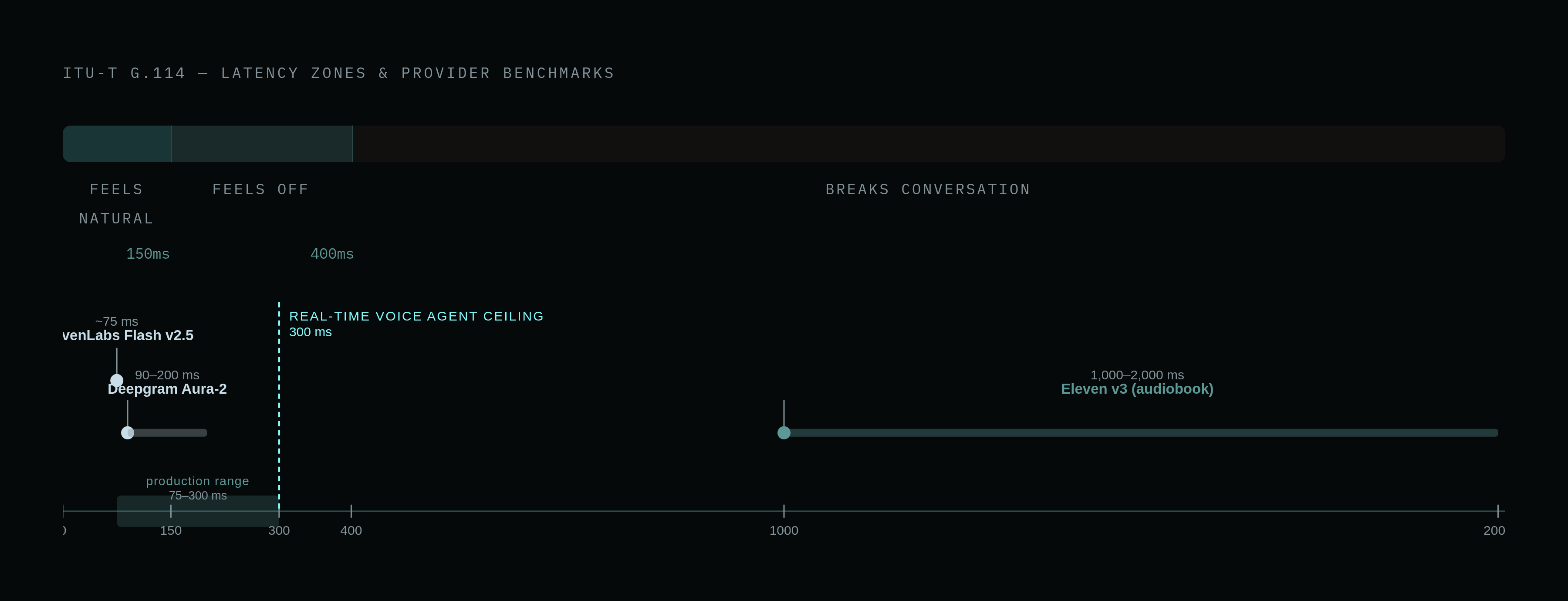
The ITU-T G.114 standard is still the bar most voice engineers work against: 0 to 150 milliseconds feels natural, 150 to 400 starts to feel off, and anything past 400 breaks the rhythm people expect from a live conversation. Real-time voice agents usually require a time-to-first-byte under 300ms, and keeping speech latency under 500 to 800 milliseconds is key to creating natural, seamless interactions in AI systems. In production, TTS time-to-first-byte typically ranges from 75 to 300 milliseconds, varying by model and infrastructure, leaving little margin for error.
If the product is a conversational agent, the provider list is already cut down before a single dollar gets compared. Some specialized models achieve time-to-first-audio near 40 milliseconds, making them strong options when speed is critical. Flash v2.5 from ElevenLabs clocks in near 75 ms. Deepgram's Aura-2 is typically under 200 milliseconds, but can be tuned near 90.
Consider Some models, like Eleven v3, have latencies of 1 to 2 seconds: they're top models designed for other tasks, like audiobooks and long-form narration, where there's no need for instant responses. Neither model outperforms the other. They're suited for distinct tasks, like how a diesel engine and a Formula 1 engine both propel a car, yet you wouldn't pit a delivery truck against a racer at Silverstone.
Hidden costs come from latency too. Slower providers require larger request queues and more concurrent connections to maintain steady throughput, forcing teams into costlier plan tiers than the character count alone would justify. So, test time-to-first-byte with real production load, not vendor website lab results. Vendors measure benchmarks under ideal conditions, just like the tests for gas mileage stickers, which are done on a flat road with no wind and apparently no traffic.
What each major provider actually costs at the volume tiers where it becomes competitive
Nobody wins on every dimension here, so the useful question isn't "who's cheapest." It's "who's cheapest for this volume, at this latency floor." Anyone still asking the first question ends up on the wrong provider for their actual traffic.
Amazon Polly costs $4 per million characters for Standard voices, $16 per million for Neural, includes a free tier of 5 million characters monthly for the first year, and limits rates to 80 transactions per second. Google Cloud TTS charges $4 per million for Standard and WaveNet (WaveNet prices lowered to match Standard in early 2026), $16 per million for Neural2, $30 per million for Chirp 3 HD, and $160 per million for Studio voices. Microsoft Azure costs $16 per million on pay-as-you-go, but falls to $7.50 per million with a 2-billion-character commitment, making it the best deal once usage exceeds 100 million characters monthly. No other neural quality option matches that rate at that scale, and teams staying on pay-as-you-go past that threshold are simply wasting money each month.
OpenAI occupies a middle ground in the market by offering something unique. OpenAI charges $15 per million characters for Standard TTS, $30 for TTS HD, and $0.60 per million input tokens for gpt-4o-mini-tts, an unrelated measure that requires conversion to compare. By default, it's limited to 500 requests per minute. OpenAI stands out because it can adjust tone: the model follows prompts like "calm and friendly," which is important when brand voice is a key requirement, not just added later.
Specialized real-time providers, designed for voice agents, reflect this focus in their pricing. Deepgram's Aura-2 costs $0.030 per thousand characters normally, but $0.027 on Growth, including 40+ voices with no extra fee per voice. Cartesia's Sonic model is designed for low latency and precise control, priced at $0.038 per thousand characters. ElevenLabs offers tiers: free for 10,000 characters, Starter at a low monthly fee for 30,000, Pro at $99 for 500,000, and Growing Business at a higher monthly fee for a large character allotment, with 3,000+ voices. Inworld's Realtime TTS-2 offers tiered pricing for different usage levels.
For teams willing to own GPU infrastructure, open-source models rewrite the math. CosyVoice2-0.5B processes audio in about 150 milliseconds and supports Chinese (with several dialects), English, Japanese, and Korean, offered by SiliconFlow at a low cost per million UTF-8 bytes. IndexTTS-2 provides zero-shot synthesis, precise duration control, and separate emotion and timbre handling, all at the same price on SiliconFlow. The trade is blunt: lowest unit cost on the market, in exchange for owning uptime, scaling, and every 3am pager alert that comes bundled with running your own inference stack.
No one provider fits all, and anyone claiming otherwise is pushing a product, not reality. Azure excels with high-volume commitment pricing. Cartesia’s the fastest. Deepgram wins on unified STT and TTS simplicity. ElevenLabs wins on voice variety. The biggest mistake teams make is choosing the provider with the fanciest documentation, instead of the one that fits their real volume and latency needs. Pretty docs don't cover bills.
The hidden costs that make the cheapest-looking provider the most expensive at scale
This is where the character-times-rate model breaks down, and it’s important to explain exactly how, since this failure happens every time. The advertised price and the invoice stop matching, and three months of bills are out before anyone notices.
Unexpected bills usually start with concurrency caps. Plans cap how many simultaneous audio streams they'll serve, and if 500 concurrent users hit a plan built for 50, the system gets forced into the next pricing tier no matter how many characters actually got processed. Cloud TTS providers often impose concurrency limits, such as 80 transactions per second, and a provider with a low per-character rate but strict concurrency limits can end up costing more than a more expensive provider with higher limits. Contact centers and voice agents are hit hardest by this. Base concurrency on peak traffic instead of average: average traffic doesn't tell the real story, while peak traffic determines your actual bill.
Egress fees rise with audio quality in a way that slips under the radar until the bill comes. A 16kHz, 16-bit mono WAV file can consume significant bandwidth, 128kbps MP3 files are smaller than WAV alternatives, and 48kbps Opus even less. With a high volume of responses daily, just the codec choice greatly changes egress volume, and this cost quickly rises as responses climb. Changing the delivery format from WAV to Opus slashes egress costs without affecting the TTS rate, a rare bargain. Most teams don’t switch, not due to difficulty, but because no one is assigned to "audit the codec."
SSML markup and retry logic pile extra costs onto the per-character rate. Each retry is charged separately, so shaky connections or heavy SSML use silently drive up character counts without a separate invoice entry.
Caching rules are often the most confusing cost factor since each provider has different terms that people don't notice until problems arise. Amazon Polly allows free caching and reuse of generated audio. Google Cloud TTS charges you every time, even for the same text, so caching becomes a must if your traffic repeats any phrases. Teams that skip this check end up paying multiple times for the same audio. Creating that cache adds storage costs, because some providers cover reuse fees while others charge the customer fully.
Audio caching as the highest-return optimization before any other change
Ignore provider choice, latency adjustments, and commitment levels for now, there's a simpler, cheaper solution that teams often overlook. Most TTS-heavy apps keep repeating the same few phrases: greetings, error messages, canned notifications, IVR prompts, the dull, repetitive core of typical voice workflows. It's the highest-return fix here, yet teams often skip it as it doesn't seem like "real" optimization work. It seems like cleaning up. It pays like a raise.
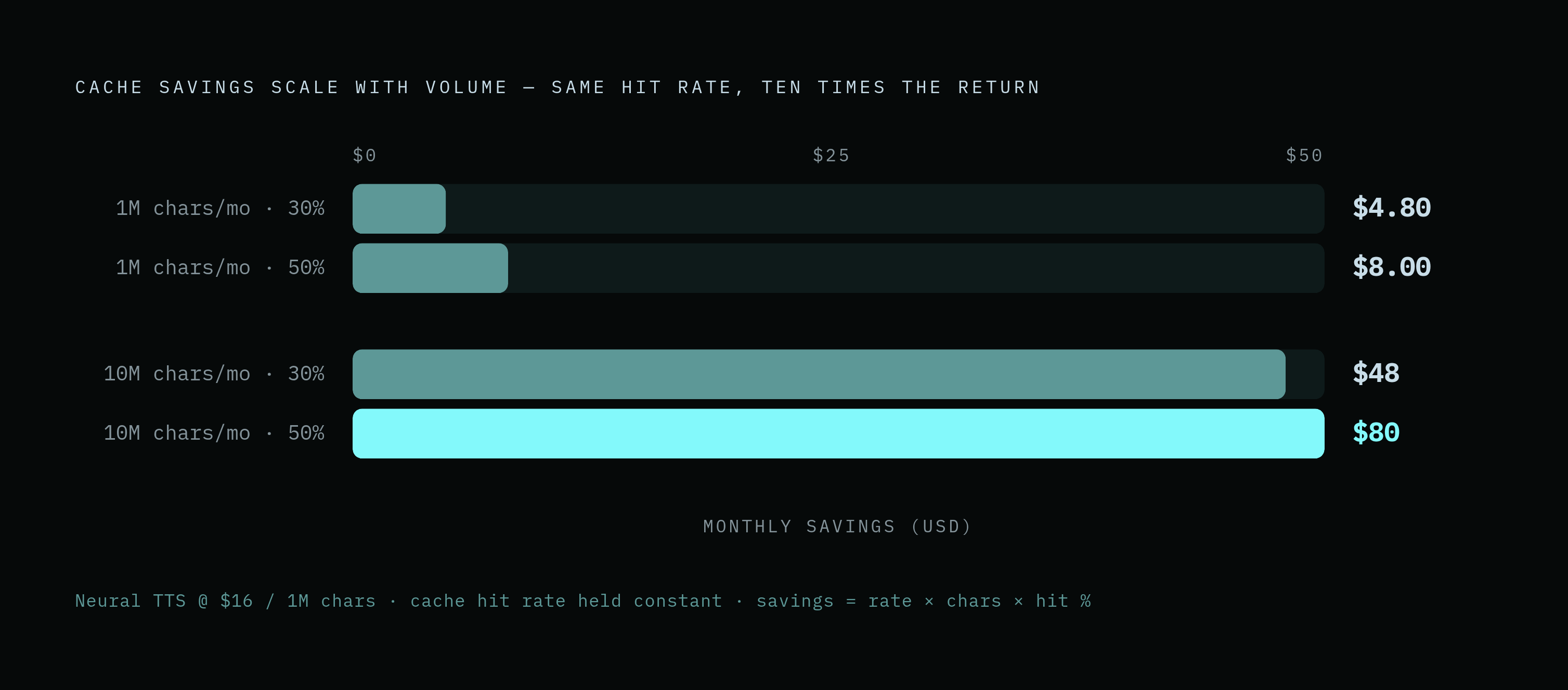
Apps with this kind of repeated content usually hit cache rates of 30 to 50%, and grabbing those hits at the audio file level reduces API spend by about the same amount, without changing anything else. Building it costs just a few hours of engineering at first, plus small ongoing storage fees that are more than covered by the saved API calls.
Some implementation details are crucial in this context. Decide on cache key design: exact text matching or normalized text that removes spaces and uses lowercase to find more similar items. TTL policy requires separate logic as well. Indefinite caching works for static phrases like greetings or legal disclaimers; dynamic items such as a customer's name or live account data need a short or no TTL. Before you code, look up the provider’s rules: Polly lets you cache freely, but Google bills every single synthesis, so the cache must run on your servers or you’ll never cut costs.
Most cost optimizations get smaller with scale, but caching's return gets bigger. A 30% hit rate at 10 million characters a month saves a lot more in absolute dollars than the same 30% hit rate at 1 million, so this isn't a one-time fix that matters less as the product grows. It matters more over time. Begin with checking the 100 most popular phrases. In many voice agent setups, that small list drives a huge chunk of total characters, just as the 80/20 rule predicts.
Throughput batching, request shaping, and the architectural levers that lower per-unit cost
Caching is done; now, savings come from request routing and shaping, not another provider change.
By far the biggest missed chance is sending batch-ready work to non-real-time endpoints. Many teams route all TTS traffic through the real-time streaming endpoint "for simplicity," and pay the latency-guarantee premium on content that doesn't need it. Pre-made audio for scheduled alerts, email-to-speech, and long narrations doesn’t need a 300-millisecond response, and sending it through batch endpoints costs a lot less. Before shipping any new feature, ask: does it need to be heard in under 300 milliseconds? If not, use batch processing and avoid unnecessary real-time fees.
Request shaping comes next. Splitting long text into sentences reduces initial wait time and allows streaming, meaning listeners hear the first part as the rest is created. Still, there's a limit that's worth respecting. If chunks are too small, per-request overhead, retry risk, and SSML processing costs grow faster than the latency gains. Providers usually pick sentence breaks as the starting point, but the best chunk size varies slightly.
Choosing the right voice model tier is the simplest concept, yet it’s often overlooked. Studio-quality voice at $160 per million characters is overkill for IVR confirmations, wasting money on a greeting that doesn't need perfect tone. Match each use case to the lowest quality tier that still satisfies user expectations, and reserve premium tiers for rare, critical customer interactions where voice quality truly matters. Google Cloud pricing WaveNet at $4 per million, the same as Standard, since early 2026 removes what used to be a real trade-off: any team still running Standard voices on that platform is leaving quality on the table for zero savings, about as close to a free upgrade as a pricing page ever offers.
The moment you pick a commitment tier ties everything back to the beginning. By themselves, batching, caching, chunking, and voice tier selection don't make much difference. They add up, and the point where a commitment tier makes sense depends completely on how much of that volume the other five have already cut. Wait to measure spend until after implementing the cheap fixes, or the commitment will be based on a number that caching would have reduced.