Streaming TTS Voice Persona Consistency Across Long-Form Output
Long-form TTS systems lose voice consistency at scale, requiring new detection methods and fixes.

- Written by
- The Voice Layer Editors
- Published
- October 7, 2026
- Reading time
- 8 min read
- Sources cited
- 2 sources ↓
What this covers
Neural text-to-speech systems can now generate short utterances that sound almost indistinguishable from a real person talking. Yet extending the output past a few sentences causes that quality to break down structurally, and this isn't simply mistakes accumulating as duration grows. Even when a model handles fifteen seconds of audio flawlessly, it may still encounter major alignment breakdowns over ten minutes, since such problems emerge only at scale and remain hidden during brief evaluations. Two archetypes illustrate why this matters. An audiobook needs a narrator who stays in character across many hours, so once chapter three strikes the ear as unlike chapter one, the listener's faith in the entire production collapses, even when every sentence is clean on its own. Consider a voice agent built for the long haul, the kind behind a coaching app, an AI companion, or a language tutor: it must carry one personality, accent, and tone through hundreds of conversational turns, not a single unbroken read. What both cases require is something short-form benchmarks leave untested: a steadiness that persists across time, not merely a quality that holds only in the moment.
The first failure mechanism: attention misalignment in autoregressive models
Most long-form autoregressive TTS failures stem from the attention drifting out of alignment, not from accumulated noise or the model broadly weakening as generation continues. In these systems, each new bit of speech is produced by tracking the relevant spot in the source text for the material being spoken, with attention breaking down in two separate ways. In a skip, the model gets ahead of the text before spending enough synthesis time on that passage, leaving words or whole phrases out of the output. In a hallucination, the decoder keeps producing sound after losing forward progress through the prompt, yielding speech that loops or invents material unrelated to the provided text. In large-scale use, neither problem is unusual, and lengthier inputs make each one both likelier and worse, so quality does not decline slowly; after a certain point, it drops sharply. MagpieTTS-LF was built to fix attention misalignment and sees the usual remedies of shortening the input, enlarging the context window, or joining separately generated segments as merely shifting the misalignment elsewhere. Speaker drift is a related but distinct issue: the voice gradually changes in perceived quality during one utterance, despite the system using a constant speaker embedding throughout. Until recently, the field lacked any consistent protocol for evaluating speaker drift, automated tools that could measure it at scale, or a benchmark built for the task, so practitioners had no dependable means of spotting it. In 2026, researchers released a framework for automation and a benchmark validated by humans to fill this void, showing that the field is just now creating the measurement tools needed for this problem.
The second failure mechanism: chunk-boundary artifacts in streaming inference
Long-form TTS streams are usually built sentence by sentence: divide input, generate speech for each unit, then stitch the resulting audio together. This usual method keeps startup delay down, but each splice introduces its own glitch and still fails to maintain the consistency the chunking was supposed to protect. At splice points, listeners hear level jumps and wavering as one chunk gives way to another, tempo changes between adjacent units, and broader prosodic shapes, such as a rising intonation arc, whose contour needs several sentences to unfold. Choosing the chunk length forces a balance between latency and coherence: short units give the vocoder too little surrounding context to smooth joins, but longer ones postpone initial playback and make the stream feel slow. MagpieTTS-LF examined XTTS and found that pitch moves smoothly between chunks, yet each chunk is loudness-normalized independently, leaving loudness sharply uneven despite the pitch staying continuous. Its measured boundary energy discontinuity was 14.04 dB, about half that of rival systems, proving boundary quality is quantifiable and improvable. Feeding an extremely long passage to some models all at once can cause the accent or language to wander partway through, most noticeably near proper nouns, so users end up having to split their text manually. Doing this by hand defeats the point of the automated TTS pipeline.
The expressiveness-consistency tradeoff
Neither attention drift nor the glitches at segment edges occur in isolation. Their interaction forces a difficult engineering decision: prioritizing naturalness invites instability, whereas enforcing consistency strips away nuance. A richer voice may capture a single chapter's feeling yet unravel over longer passages, whereas a steadier one preserves vocal character at the cost of emotional depth. Such a compromise reveals an overlooked gap in current assessment methods. During extended evaluations, any voice whose pitch wandered after a fixed span of uninterrupted generation was rejected immediately, regardless of how authentic its opening moments seemed. Standard brief-sample tests miss this flaw entirely, since it emerges only over extended runs. Public leaderboards use blind A/B tests on brief English audio, failing to assess brand voice consistency, product name pronunciation, or whether prosody stays coherent over long passages. A model's placement in these rankings offers no guidance for long-form production decisions. A further complication emerges when vendors silently modify backend systems while keeping version labels intact, meaning approved voices may shift over time with no apparent indication of alteration. Persona consistency isn't a one-time fix you implement during generation; continuous post-deployment monitoring is essential.
Inference-time approaches to detecting and repairing alignment failures
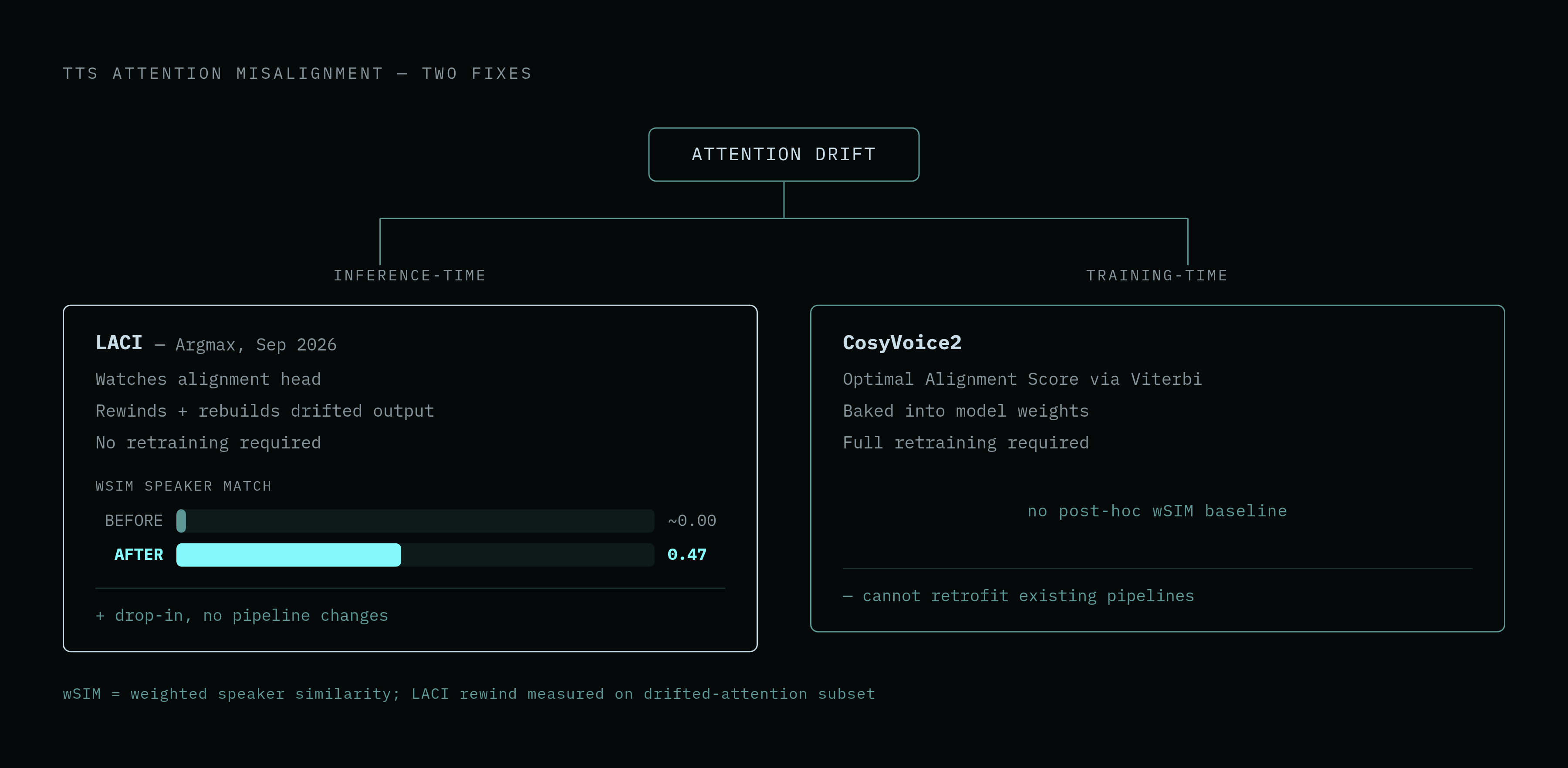
A practical fix for attention misalignment can run solely during inference, leaving the underlying model unretrained and suiting teams locked into a base model they cannot easily replace. Released in September 2026 by Argmax, LACI (Localized Attention-Constrained Inference) watches an alignment head as the model runs, identifies attention drift almost immediately, rewinds output to where the issue first appeared, then rebuilds that portion with short-lived constraints in place. With speaker match scored by wSIM, the system rose to 0.47 from near-zero across a large reference audio sample, salvaging a case that otherwise would have broken down. LACI’s architectural draw is its inference-only design: teams can add it over an existing model without revisiting training, an advantage for groups that lack the budget to retrain or replace the foundation they are using during rollout. Other research takes the position that alignment quality needs to be corrected at its root, while the model is being trained. By embedding the Optimal Alignment Score method, which applies Viterbi to gauge how well text matches speech, CosyVoice2 learns steady, unbroken alignment from the outset. Because this approach requires retraining, a team cannot simply plug it into a pipeline they already have. These two camps reflect a real disagreement about where the solution should go, and no single answer has prevailed.
Architectural strategies for prosodic continuity across chunk boundaries
Addressing chunk-boundary artifacts demands a different strategy than correcting attention misalignment, since the model must maintain state or context spanning chunk boundaries rather than generating each chunk separately and joining them later. MagpieTTS-LF addresses this through a trio of coordinated mechanisms. Soft attention priors encourage monotonic alignment yet retain context from before and after. During generation, an inference procedure with memory preserves prosodic continuity between sentence chunks. History-aware text encoding loops earlier text into the model, letting it shape prosody across the entire discourse and not merely the current sentence. These three mechanisms are applied only during inference, need no long-form retraining, and align with LACI in focusing on chunk-boundary artifacts. SpeakStream reaches that shared aim by another route: with decoder-only dual-streaming TTS, it keeps generated chunks cached as keys and values so session-wide context remains intact, and it uses end-of-sequence token prediction for boundary placement to prevent misalignment without relying on CTC alignment during inference. Qwen3-TTS takes a different tack, seeking continuous, prosodically consistent audio over the whole output through a design that dispenses with chunking; the 25Hz version beats the 12Hz version in extended-generation robustness, indicating that chunk-boundary problems may be handled inside the architecture itself. Microsoft’s VibeVoice, released as open-source research, sketches another path: its next-token diffusion design pairs LLM-level context modeling with detailed high-fidelity acoustics to preserve speaker identity over long audio spans. VibeVoice has not yet become a production system, remains available only for English and Chinese, and its realtime mode handles just one speaker, so for now it is more a signpost than a deployable answer.
Production-grade long-form consistency across current TTS systems
Today’s options still force a tradeoff, with the best fit turning on scripted extended audio versus responsive multi-turn dialogue. With Story Studio, introduced in December 2025, Fish Audio lets teams handle audiobook chapters as separate units for creation and revision, so fixing one chapter never means you have to regenerate the whole book. FishAudio-S1, the model behind it, lets practitioners steer expression sentence by sentence in open-domain work with 48 emotion tags while preserving cohesion across the full production. For ElevenLabs, Projects supports coherent extended narration; Eleven v3 entered general availability February 2, 2026. Eleven v3 handles over 70 languages with speaker labels and multi-voice exchanges, yet a per-call text limit keeps it restricted to prerecorded media. Within the Audiobooks feature, Character Casting handles up to 150 detected voices per book, while cloning a voice demands a minimum of 30 minutes of training audio. Previous ElevenLabs versions sounded precise yet lacked feeling, but v3 conveys suspense, affection, pauses, and varied rhythm. The free plan allows 10,000 monthly characters, Creator costs $22 each month, Pro runs $99 monthly, and Scale covers larger needs beyond those.
Conversational use cases call for a different set of tools. Cartesia's Sonic-3.5 is built around interactive games and companion-AI products, and its developer ergonomics favor character voices, emotional range, and a persona that holds steady across long sessions, the right fit when the agent is meant to be a character in a game or companion app. Its sub-90ms time-to-first-audio makes it the strongest current option where latency is the binding constraint. Inworld AI's Realtime TTS-2, which entered research preview in May 2026 and reached general availability in September 2026, targets multi-turn conversational context directly: under 100ms time-to-first-byte, free-form natural-language steering over emotion, articulation, intonation, volume, pitch, range, speed, and vocal style, and voice identity that holds across languages. It supports SSML breaks and experimental audio markups, English-only and still experimental, for steering long-form delivery, and the recommended practice is sparse, deliberate markup placed only where a conversation genuinely calls for it, since heavy markup repeated across many turns starts to read as theatrical. Full conversationality, in which every prior turn informs the prosody the system produces, is still a research goal rather than something shipped; the approach in production today is steering, in which the developer explicitly instructs the model on each utterance. Inworld likewise bought Ultravox, using the deal to strengthen the voice technology it runs in real time and to lay groundwork for a coming wave of AI products aimed at consumers. Hume AI's TADA gives teams that would rather run their own stack than lean on a provider an open-source, no-cost path, with the cost shifting wholly onto the burden of operating and upkeep. Seen together, these platforms confirm the argument this piece has been assembling: misaligned attention and artifacts at chunk boundaries are distinct engineering issues, and tooling that excels at one seldom proves strongest at the other.
Methodology & sources
- MagpieTTS-LF: Inference-Time Long-Form Speech Generation Without Training on Long-Form data
Provided the technical details on attention misalignment mechanisms, the XTTS boundary energy discontinuity measurement of 14.04 dB, and the three coordinated inference-time mechanisms for prosodic continuity.
- Taming Long-form Text-to-Speech
Provided the basis for the claim that alignment breakdowns in long-form TTS remain hidden during brief evaluations, and informed the discussion of LACI's alignment head monitoring approach.